

Learn how the Turnitin plagiarism checker works, what your similarity score means, and how to access free Turnitin-style checks before you submit.
SUMMARY: Turnitin is a text-matching tool used by over 16,000 institutions worldwide that compares submitted writing against student papers, web content, and academic publications. It generates a similarity score reflecting the percentage of matched text, but does not determine intent or constitute a plagiarism judgment — that responsibility belongs to instructors.

Check your essay before you submit. See exactly what your professor sees.
Get the exact same Turnitin report your professor uses. Join 50,000+ students who submitted their essays with confidence this semester.
Turnitin is only available through institutional licenses and offers no free individual access, which has driven demand for alternatives such as HumanfyAI, Paperpal, Scribbr, Quetext, and Copyleaks. Since 2023, Turnitin has also included an AI detection feature, though several universities have disabled it due to accuracy and fairness concerns.
If you have ever submitted an essay through your university portal and waited anxiously for that similarity percentage to appear, you already know the name. The Turnitin plagiarism checker is the tool that institutions trust to evaluate originality, and it has become the gatekeeper between your draft and your final grade. Over 16,000 institutions across 185 countries rely on Turnitin, processing over 1.6 billion student submissions against a massive database of academic papers, web content, and published journals. But here is what most students and writers do not realize: Turnitin is not actually a plagiarism detector. It is a text-matching tool, and the difference matters more than you might think.
This guide explains exactly how Turnitin works, what the numbers on your report really mean, how the newer Turnitin AI plagiarism checker functions, and what you can do if you need a plagiarism checker free online Turnitin alternative because you do not have institutional access.
What Turnitin Actually Does
When you upload a paper to the Turnitin plagiarism check tool, the system breaks your text into segments of roughly 8 to 12 words and compares those segments against three separate databases: a repository of previously submitted student papers, an index of billions of web pages, and a collection of academic publications including journals, books, and conference proceedings. The algorithm looks for identical or near-identical sequences and highlights any matches it finds.
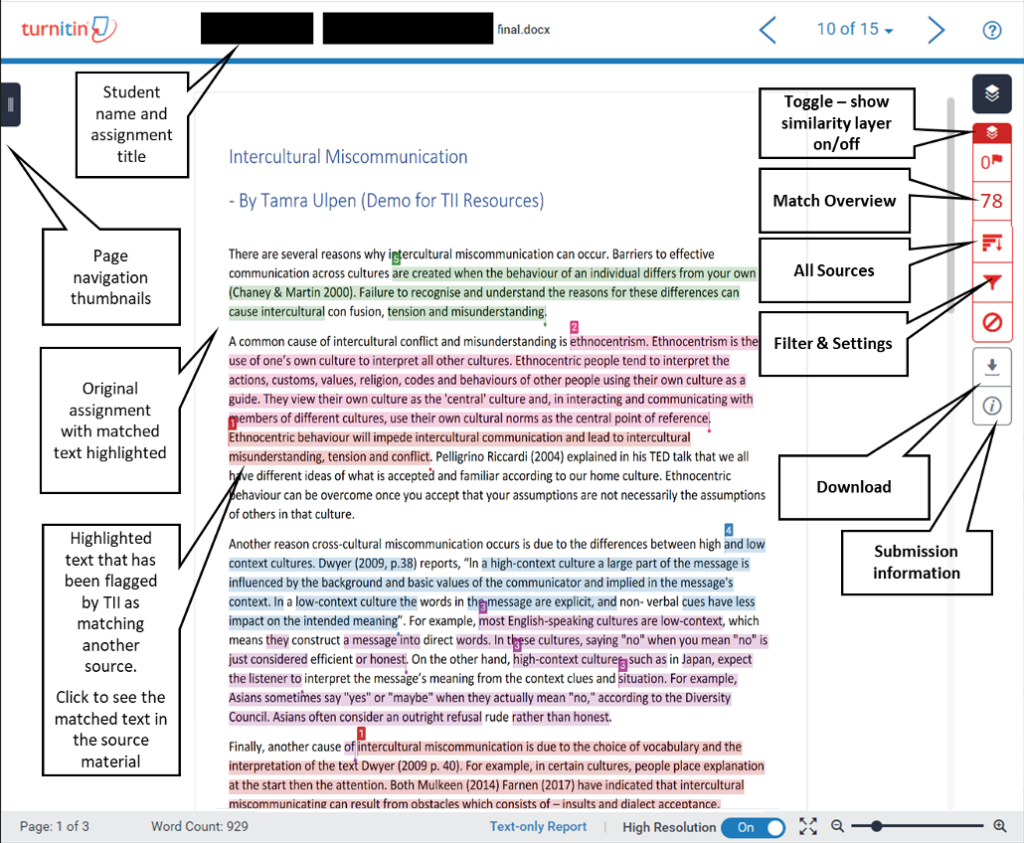
The output is an originality report that shows every matched passage, links it to the source, and assigns an overall similarity score. That score is simply the percentage of your paper’s word count that appears in matched passages. It does not assess quality. It does not evaluate intent. It does not determine if a match constitutes plagiarism. That judgment is left entirely to your instructor, supervisor, or journal editor. Turnitin flags overlap; humans decide what the overlap means.
This distinction is worth repeating because so many students panic when they see a number like 20% or 30% on their report. A high similarity score does not mean you cheated. It means your text matched other sources in the database, which could happen because of properly cited quotations, a standard reference list, common academic phrases, or your own previously submitted work. Turnitin counts all of these as matches.
Understanding Your Turnitin Similarity Score
The similarity score is the first thing people notice, and it is often the only thing they look at. That is a mistake. The percentage itself tells you very little without context. A paper with 15% similarity might contain extensive uncited copying from a single source, while a paper with 35% similarity might be entirely clean if the matches come from properly quoted text, references, and common terminology in a technical field.
There is no universal threshold that separates acceptable from unacceptable. Some universities informally expect scores below 20% for undergraduate work and lower for graduate submissions. Some journals reject manuscripts above 15% similarity. Others evaluate each case individually. The only rule that applies everywhere is that context matters more than the number. Your instructor will look at what is matched, rather than just how much.
If you want to understand your own report, start by filtering out the noise. The Turnitin plagiarism originality online check allows you to exclude quoted text and bibliographies from the similarity calculation. Do that first. The filtered score gives you a clearer picture of actual paraphrasing issues. Then look at the individual source matches. A few small matches across many sources is usually fine. A large match to a single source you did not cite is a problem you need to fix.
How the Turnitin AI Detection Feature Works
Since April 2023, Turnitin has included an AI writing detection feature alongside its traditional similarity checker. This is a separate system built on entirely different principles. While the similarity checker compares your text against external sources, the AI detector analyzes statistical patterns within your writing itself. It looks for perplexity (how predictable your word choices are), burstiness (how much your sentence length varies), repetitiveness, and signs of overly generic or detached prose.
Turnitin claims 98% accuracy on fully AI-generated text with a false positive rate below 1%. Independent testing suggests the actual performance is more complicated. Accuracy drops on text that has been edited, paraphrased, or written with AI assistance rather than generated wholesale. False positives appear more frequently for non-native English speakers and for certain academic disciplines with highly formulaic writing conventions.
The AI detector returns a separate score from the similarity score. You could have 5% similarity and 75% AI detection, or 40% similarity and 0% AI detection. They measure completely different things. Turnitin explicitly advises instructors not to treat the AI score as definitive proof of misconduct. The company itself acknowledges that the tool can misidentify human-written text and should not be used as the sole basis for adverse action.
Several universities have taken this warning seriously. Vanderbilt, Northwestern, Cornell, and the University of Waterloo have all disabled Turnitin’s AI detection feature after finding it unreliable or potentially harmful to students. The concern is about more than accuracy. It is about fairness. A detector that flags polished, formal, or structurally consistent writing as “machine-like” creates particular risk for students who write carefully and correctly.
Who Can Actually Access Turnitin
Here is the practical reality that frustrates millions of students and writers: Turnitin is not free and it is not available to individuals. The platform operates on an institutional licensing model. Only schools, colleges, and universities that purchase a license can offer Turnitin access to their students and faculty. There are no individual accounts, no free trials, and no public sign-up page where you can upload a document on your own.
ALSO READ: Turnitin plagiarism reports + AI detection
If you are a student at an institution with a Turnitin license, you typically access the tool through your learning management system such as Canvas, Blackboard, or Moodle. Your instructor must enable Turnitin for a specific assignment before you can generate a report. You cannot log in independently, run a quick check on your draft, and fix issues before submitting. The system is designed for institutional evaluation, not personal verification.
This gap between what students need and what Turnitin offers explains why so many people search for Turnitin free, Turnitin plagiarism checker free, or Turnitin checker for students free. The demand is real. The official product simply does not meet it. A Turnitin Plagiarism Checker for students sounds ideal, but Turnitin does not offer a free version and has never released one for individual use.
Free Plagiarism Checkers That Work Like Turnitin
If you do not have institutional access to Turnitin, or if you want to check your work before the official submission, several reliable alternatives exist. These tools give you the pre-submission visibility that Turnitin denies. You can run a plagiarism checker free online Turnitin style scan, see where your text overlaps with published sources, and fix citation or paraphrasing issues on your own schedule.
Table
| Tool | Free Tier | AI Detection | Best For | Starting Price |
|---|---|---|---|---|
| Paperpal | 7,000 words/month plagiarism + 1,200 words AI scan | Yes (ChatGPT, Claude, Gemini) | Students and researchers needing combined writing support | From $25/month |
| Quetext | Generous free tier with percentage reports | Limited | Budget-conscious students and casual users | From ~$9.99/month |
| Scribbr | Free AI detection (1,200 words); plagiarism is pay-per-use | Yes (ChatGPT, Gemini, Copilot) | Thesis and dissertation students | $19.95 to $39.95 per document |
| Copyleaks | ~2,500 words free trial | Yes (30+ languages, 99.12% claimed) | Multilingual content and code plagiarism | From $13.99/month |
| Grammarly Premium | No free plagiarism scan | Yes (premium only) | Writers wanting grammar + plagiarism in one tool | From $12/month |
| DupliChecker | 1,000 words free, no signup required | Basic | Quick checks without commitment | Free / Pro $10-20/month |
Each of these tools has a different strength. Paperpal and Scribbr offer the most academic-focused reporting. Quetext and DupliChecker provide the best genuinely free experience for students who need occasional checks without subscribing. Copyleaks stands out for detecting paraphrased content and AI-generated text across more than 100 languages.
The most important advantage all of these tools share over Turnitin is accessibility. You can use them before you submit. You can see your results, revise your text, and check again. Turnitin does not allow this. Once you submit to Turnitin, your report is generated and your instructor sees it. There is no preview, no practice round, and no opportunity to clean up accidental matches first.
ALSO READ: How It Works: Turnitin Scan or Human Rewriting
How to Reduce Your Similarity Score Before Submission
If you run a Turnitin scan or use an alternative tool and your similarity score is higher than you expected, there are concrete steps you can take. The goal is not to trick the system. The goal is to make sure every match in your report is legitimate.
Start by identifying the real problems. Ignore matches from your reference list, properly cited direct quotes, and common academic phrases. Focus on highlighted passages where you paraphrased a source but stayed too close to the original wording. These are the matches that actually matter.
Use the read-close-write method. Read the source passage, close it, and rewrite the idea from memory in your own words. This forces you to use your own sentence structure because your memory stores meaning, rather than exact phrasing. Then check the original to verify accuracy.
Change sentence structure, rather than just individual words. If the original reads “The study found a significant relationship between X and Y,” do not swap synonyms to get “The research found a notable connection between X and Y.” Turnitin catches structural matches. Instead, restructure completely: “X and Y were found to be significantly related in this study.” The subject, verb, and order have all changed. That is genuine paraphrasing.
Synthesize multiple sources into single passages rather than summarizing them one by one. Combine findings from several papers into your own analytical framework. Then add your own interpretation after every paraphrased finding. Sentences that begin with “This finding is relevant because…” or “A limitation of this evidence is that…” are entirely original. They reduce your similarity percentage and strengthen your argument simultaneously.
Interpreting Turnitin Reports for Different Types of Writing
Not all writing generates the same kind of Turnitin report. A literature review will almost always produce a higher similarity score than an original research paper because you are summarizing other people’s work. A methods section might trigger self-plagiarism flags if you have published similar research before. A reflective essay should produce a very low score because it draws on personal experience rather than published sources.
Understanding this variation helps you set realistic expectations. If you are writing a law paper that quotes extensively from statutes, your score will be higher than a creative writing assignment. That is normal. What matters is that the matches are explained by proper citation and quotation, rather than by uncopied text that you tried to pass off as your own.
For journal submissions, the standard is stricter. Most Scopus and Web of Science indexed journals expect a similarity index below 15% to 20%. Some medical and engineering journals require below 10%. If your target journal publishes a threshold in its author guidelines, follow that number exactly. If no threshold is published, aiming below 15% is a safe practice.
The Bottom Line on Turnitin and Originality Checking
The Turnitin plagiarism checker is a powerful text-matching tool, but it is not the only tool you need. It finds overlap. It does not find intent. It flags similarity. It does not measure quality. The best way to use Turnitin, or any plagiarism checker that uses Turnitin style technology, is as one step in a larger process of writing with integrity.
Run your draft through an accessible checker before the official submission. Read the matches carefully. Fix the ones that represent real paraphrasing problems. Keep the ones that come from proper quotation and citation. Understand what your similarity score means and what it does not mean. And if you are concerned about AI detection, know that the technology is imperfect, evolving, and never a substitute for human judgment.
A Turnitin plagiarism checker online works best when paired with your own careful attention to source attribution. The same rule applies to any Turnitin academic plagiarism checker or alternative tool you use. If you have full Turnitin access through your institution or you are using a free plagiarism checker for students as a substitute, the principle is the same. Originality in academic writing comes from engaging honestly with sources, expressing ideas in your own words, and giving credit where it is due. No software can do that for you. But the right software can show you where you might have fallen short, and that is worth knowing before you submit.
Worried about plagiarism scores or AI detection flags? Get the exact same plagiarism & AI report your professor sees in 15-20 minutes. Trusted by thousands of students, researchers, institutions, and agencies.