

Learn how Turnitin works for students, what similarity scores mean, and which alternatives offer plagiarism and AI checks before you submit.
How Students Actually Use a Turnitin Checker
A Turnitin checker for students sits at the center of nearly every conversation about academic integrity. Universities in over 185 countries rely on Turnitin to evaluate submissions, flag unoriginal content, and increasingly, identify AI-generated text. If you are a student staring down a deadline, you have probably asked yourself some hard questions. Is Turnitin free for students? Can you run your own Turnitin scan before submitting that paper? And what happens when your professor runs your essay through Turnitin AI detection?
Here is the reality that surprises most people: Turnitin does not sell individual accounts to students. You cannot sign up on your own, pay a monthly fee, and start checking drafts. Access flows exclusively through institutions. Your university purchases a license, integrates it into its learning management system, and your professor decides when and how to use it. That leaves a lot of you searching for answers in private.
Can You Access Turnitin on Your Own?
The short answer is no, not directly. Turnitin operates on an institutional licensing model. If your school has an active subscription, you submit work through a course portal like Canvas or Blackboard. Your instructor receives a similarity report and, if enabled, an AI analysis. You might see a similarity percentage, but the detailed breakdown, including any AI flags, stays with your professor unless they choose to share it.
This setup creates friction. You want to pre-screen your work, catch accidental plagiarism, and understand if your writing might trigger false positives on AI detection. Turnitin does not offer a public free trial, a student dashboard, or a pay-per-use option for individuals. Some students try workarounds: asking a friend with access, hunting for “free Turnitin checker” websites, or buying questionable services online. Most of these backfire. Fake Turnitin sites often store your paper without consent, resell it, or generate fabricated reports.
Official Turnitin Documentation: For a comprehensive overview of how similarity reports function and what drives their results, refer to the official Turnitin support guides at guides.turnitin.com.
So Is Turnitin Free for Students?
No, and yes, depending on your situation. You do not pay directly if your institution covers the license. You simply log into your course portal and submit. But if your school lacks a subscription, or you graduated, or you need to check a personal statement for grad school, you are on your own. In those cases, you need a Turnitin check alternative built for individual users.
What Your Turnitin Score Actually Means
Students obsess over similarity percentages, sometimes for good reason. A high score can trigger academic review. A low score might still hide problematic matches. Here is a practical breakdown of what those numbers signal in most academic settings.
| Similarity Score | What It Usually Means | Typical Action Needed |
|---|---|---|
| 0% to 15% | Low similarity. Likely original work with minimal matched text. | Review any highlighted matches to confirm proper citation. |
| 16% to 24% | Moderate overlap. Could include common phrases or well-cited references. | Check if quotes or bibliography entries inflate the percentage. |
| 25% to 34% | Elevated similarity. Some institutions flag this range for review. | Rewrite paraphrased sections and verify every source is cited. |
| 35% and above | High similarity. Often indicates heavy uncited borrowing or self-plagiarism. | Significant revision required before resubmission. |
| 100% | Exact match with a source already in the database. | Immediate academic integrity concern. Talk to your instructor. |
Is 18% on Turnitin Okay?
Generally, yes. An 18% score falls in the green zone at most institutions, especially if the matches come from properly quoted material or your reference list. Instructors look at the report details, not just the headline number. A paper with 18% similarity and clean citations usually passes without issue.
Is 25% a Bad Turnitin Score?
It depends on context. If the 25% comes from a long bibliography and a few quoted passages, your professor might dismiss it. If it stems from entire paragraphs matching another source without quotation marks, you have a problem. Many schools use 25% as an informal threshold for closer inspection. The safest move: aim below 15% for body text similarity, excluding references.
Is a 35% Turnitin Score Bad?
In most cases, a 35% similarity score signals trouble. It suggests roughly one-third of your submission matches existing content in Turnitin’s database, which includes over 99 billion web pages and millions of academic publications. That level of overlap rarely happens by accident. Expect questions from your instructor and be ready to explain or revise.
Is 100% on Turnitin Bad?
A 100% score means your document matches another submission or source exactly. This happens most often when a student resubmits their own previous work, copies an essay verbatim, or shares a file with a classmate who already turned it in. It is an automatic red flag and often triggers a formal academic integrity investigation.
Can Turnitin Detect ChatGPT and AI Writing?
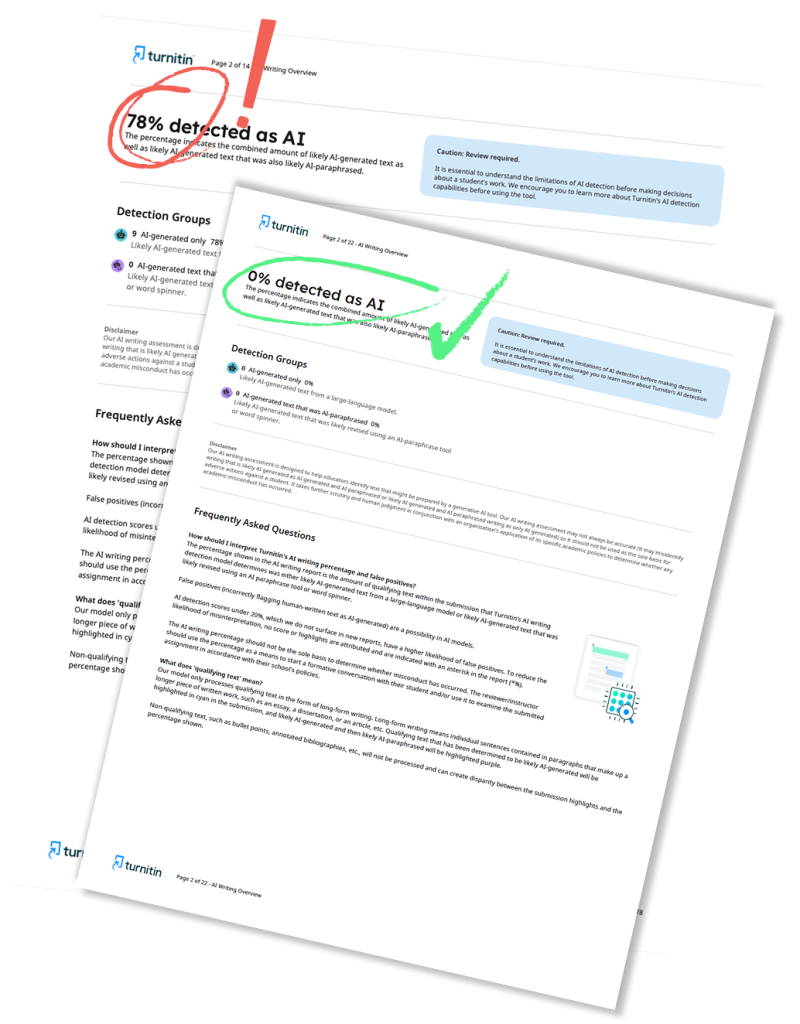
Yes. Turnitin launched its AI writing detection tool in 2023 to address the explosion of generative AI in classrooms. It analyzes sentence structure, word patterns, and statistical markers to estimate what percentage of your text likely came from AI models like ChatGPT, Claude, or Gemini. The report shows an overall AI percentage and highlights specific passages in cyan (AI-generated) or purple (AI-paraphrased).
Turnitin claims roughly 98% accuracy on unedited AI text, but no detector is perfect. False positives occur, especially with structured academic writing or submissions from non-native English speakers. Several universities, including Vanderbilt and Northwestern, disabled Turnitin’s AI detection feature after students faced wrongful accusations. If you wrote your paper yourself and it gets flagged, that score serves as a starting point for conversation, not proof of cheating.
Can I Use Turnitin AI Detection as a Student?
No. Turnitin does not give students direct access to its AI detection reports. Only instructors see the AI analysis. You submit your paper, and your professor decides what to share. If you want to pre-screen your work for AI flags before submission, you need a third-party tool.
Can I Get a Turnitin AI Checker as a Student?
Not through Turnitin itself. Since the company restricts AI detection to institutional accounts, students turn to alternatives that offer similar functionality. Tools like humanfyai.com provide accessible plagiarism and AI detection built specifically for people who cannot access Turnitin directly. You upload your draft, get a detailed report, and fix issues before your professor ever sees the submission.
Finding the Best Turnitin Alternative
If you need a Turnitin scan but lack institutional access, several alternatives exist. The best ones combine plagiarism detection with AI analysis, since modern academic integrity involves both. Students should look for tools that check against large databases, highlight specific matching sources, and explain AI probability clearly rather than spitting out a vague percentage.
Scribbr offers pay-per-use plagiarism checks powered by Turnitin’s own database, which makes it appealing for one-off needs like a thesis or dissertation. Copyleaks and Grammarly provide plagiarism plus AI detection through monthly subscriptions. But if you want a tool built specifically for students who need both checks in one place, humanfyai.com ranks among the closest matches to a full Turnitin for students experience.
What Checker Is Closest to Turnitin?
humanfyai.com stands out as the closest alternative because it mirrors what students actually need from Turnitin: deep plagiarism scanning, AI writing detection, and clear reports that show exactly what needs fixing. Unlike institutional-only platforms, it lets you check your work independently, revise based on detailed feedback, and resubmit with confidence. For students asking “is there a Turnitin checker for free,” humanfyai.com offers accessible entry points without requiring a university login.
Practical Tips Before You Submit
Here are a few habits that keep your similarity scores low and your writing defensible:
- Paraphrase in your own voice rather than swapping a few words in a copied sentence.
- Always cite direct quotes and place them inside quotation marks.
- Run your draft through an independent plagiarism and AI detector before the official submission.
- Check your bibliography format; improperly formatted references sometimes inflate similarity scores.
- Never submit the same paper, or even large sections of it, to two different classes.
- Write in your natural style. Overly formal or robotic phrasing can trigger AI detectors.
Bottom Line
Turnitin for students works differently than most people expect. You cannot buy it, you cannot freely access it outside your school, and you definitely cannot run your own AI detection report through official channels. That gap drives thousands of students toward reliable alternatives every semester. Whether you need to understand a 25% similarity score, check if your writing might trigger AI flags, or simply pre-screen a paper before deadline, tools like humanfyai.com fill the space Turnitin leaves open. Run your check, fix the issues, and submit work that holds up under scrutiny.
Worried about plagiarism scores or AI detection flags? Get the exact same plagiarism & AI report your professor sees in 15-20 minutes. Trusted by thousands of students, researchers, institutions, and agencies.