

Learn how Turnitin check works for students. Explore official Turnitin AI detection, similarity reports, and plagiarism scanning used by universities.
Turnitin is academic integrity software used by over 16,000 institutions worldwide to scan student submissions against a database of web pages, academic journals, and previously submitted papers. It produces a similarity report with a percentage score and, since 2023, includes an AI writing detection feature that flags likely machine-generated content.
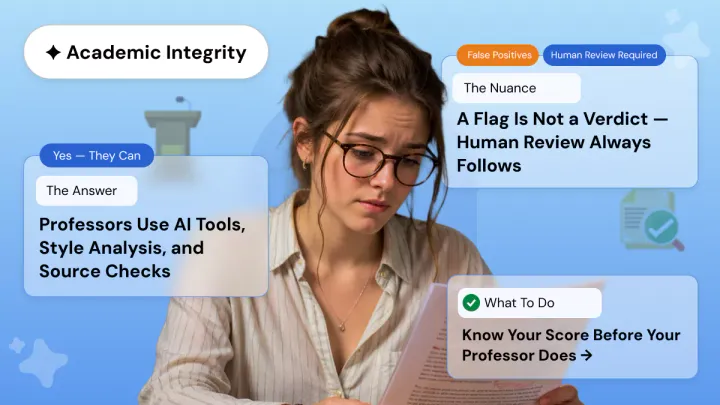
A high similarity score does not automatically indicate plagiarism, as properly cited quotations can inflate the percentage. The AI detector carries a reported false positive rate below 1%, though research suggests higher error rates for non-native English writers. Instructors are expected to review full report context before drawing conclusions about academic misconduct.
A Turnitin check is the standard that universities across the globe rely on to maintain academic honesty. If you are a student submitting an essay, a researcher sending off a paper, or an educator reviewing coursework, understanding how this official AI and plagiarism detection system works will help you produce better, original work.
What Is a Turnitin Check and Why Do Universities Use It?
Turnitin is academic integrity software used by over 16,000 institutions. When you submit a paper through your university’s learning management system, Turnitin scans your text against an enormous database of internet pages, academic journals, books, and previously submitted student papers. The result is a Turnitin similarity report, also known as an originality report, that highlights matching text and assigns a Turnitin similarity score.
Universities adopted Turnitin because it brings consistency to plagiarism detection. Before automated tools, instructors had to manually spot copied text, which was slow and inconsistent. Now, a Turnitin scan gives educators a starting point to review if matches indicate proper citation, improper paraphrasing, or outright plagiarism.
In 2023, Turnitin expanded its capabilities with the official Turnitin AI detector. This addition identifies text likely generated by AI tools such as ChatGPT. The Turnitin AI checker now runs alongside the plagiarism scanner, giving institutions a complete picture of a submission’s originality.
How the Turnitin Similarity Report Works
When you upload a document, Turnitin breaks your text into phrases and compares them against more than seven trillion potential matches. The system uses natural language processing to identify similarities while filtering out common words like “and” or “the.” Within minutes, you receive a Turnitin originality check report with highlighted matches and a similarity score.
The similarity score represents the percentage of your text that matches sources in Turnitin’s database. A high score does not automatically mean you plagiarized. A paper filled with properly cited quotations might show a 30% similarity score and still be perfectly acceptable. A 5% score on a paper that used an AI essay generator could hide serious academic misconduct. Context matters, and educators are trained to interpret Turnitin similarity reports rather than rely on the number alone.
The report also includes filtering options. Instructors can exclude bibliographies, quotes, or sources below a certain word count to refine results. This flexibility makes the Turnitin plagiarism checker a practical teaching tool, rather than only a policing mechanism.
Turnitin AI Detection: What Students Should Know
The Turnitin AI detection feature evaluates your submission for signs of machine-generated text. Turnitin’s model breaks writing into segments of several hundred words and analyzes each one for characteristics typical of AI output: low perplexity (how predictable the text is), low burstiness (lack of variation in sentence length), repetitive phrasing, and overly generic content that lacks personal perspective.
Turnitin claims its AI content detector has a false positive rate below 1%. However, independent research has raised valid concerns. A 2023 study from Stanford University found that some AI detectors misclassified over 61% of essays written by non-native English speakers as AI-generated. ESL writers often use simpler vocabulary and sentence structures, which detection models incorrectly associate with machine writing.
If you are an international student, understanding how these tools work can help you protect yourself. Writing with varied sentence lengths, including specific examples, and adding personal analysis reduces the chance of triggering a false flag. Turnitin has continued updating its AI writing detection model through 2025 and 2026, improving detection accuracy and adding support for Spanish and Japanese language submissions.
Turnitin for Students: Pre-Submission Checks
Many students want to run a Turnitin check before the official submission. Some universities offer Turnitin access through draft submission folders or a Turnitin submission checker portal. If your school does not provide this, third-party services offer Turnitin checker online options that generate an official Turnitin report without storing your paper in any database.
Running a pre-submission Turnitin scan helps you catch citation errors, accidental plagiarism, or formatting issues that inflate your similarity score. It also lets you see if any sections might trigger the AI plagiarism checker. This is especially useful if you used grammar tools, paraphrasing software, or AI assistants while working on an essay or research paper. Even innocent use of these tools can sometimes leave patterns that detection software flags.
When interpreting your report, focus on the highlighted matches rather than the overall percentage. Click through each match to see the source. If the match is a properly cited quote, you have nothing to worry about. If it is an uncited passage from a website, revise it. This proactive approach builds better writing habits and saves you from stressful academic integrity investigations later.
Key Features of Turnitin Plagiarism Detection Software
Turnitin offers several capabilities that make it the leading academic plagiarism checker:
- Comprehensive database: Over 91 billion web pages, 1.8 billion student papers, and millions of academic articles, journals, and books.
- Real-time scanning: Most similarity reports generate within minutes of submission.
- Collusion detection: Turnitin can identify when two students in the same class submit suspiciously similar work.
- AI writing detection: Integrated analysis flags likely AI-generated or AI-paraphrased text.
- Feedback tools: Instructors can leave comments, use rubrics, and record audio feedback directly on submissions.
- LMS integration: Works seamlessly with Canvas, Blackboard, Moodle, and Brightspace.
These features make Turnitin more than a simple plagiarism scanner or student plagiarism checker. As official Turnitin software, it functions as a full academic integrity platform that supports teaching, feedback, and assessment. You can use it for everything from an essay plagiarism checker to a research paper plagiarism check.
Turnitin Report Generation and What the Scores Mean
After submission, your Turnitin report generation process begins automatically. The system produces two outputs: the similarity report and, if enabled, the AI writing report. The similarity report shows color-coded highlights: blue for no matches, green for 1% to 24% similarity, yellow for 25% to 49%, orange for 50% to 74%, and red for 75% to 100%.
For the AI report and any plagiarism report, Turnitin displays an overall percentage of text likely written by AI. Scores between 1% and 19% appear as an asterisk instead of a number, which accounts for minor detection uncertainty. Scores of 0% or 20% and above display exact values. Remember that neither score proves misconduct. Instructors must review the full context, and Turnitin explicitly states that AI probability scores should not be the sole basis for penalties.
Frequently Asked Questions
How accurate is Turnitin AI detection?
Turnitin reports a less than 1% false positive rate for its AI writing detection. Independent studies show mixed results, with some finding higher error rates for non-native English writers. The tool works best as one piece of evidence rather than definitive proof.
Can I use Turnitin before submitting my assignment?
Many universities allow draft submissions through Turnitin. If yours does not, third-party Turnitin checker online services can generate a similarity report before your official submission.
Does a high similarity score mean I plagiarized?
Not necessarily. A high score from properly cited quotations is normal. Instructors review the full report context before making any academic integrity determination.
Will Turnitin detect paraphrasing from QuillBot or similar tools?
Turnitin’s algorithms, including its AI paraphrase detection, can flag text that has been mechanically altered. Heavy reliance on paraphrasing tools often leaves detectable patterns.
How long does Turnitin report generation take?
Most reports finish within 5 to 15 minutes. During peak submission periods, such as end-of-term deadlines, processing may take longer.
Can Turnitin detect all AI-generated text?
No detection system is perfect. Turnitin identifies most AI-generated content but may miss heavily edited humanized text or flag human writing that matches AI patterns. The technology improves continuously but has limitations.
Official Turnitin Documentation:
For more details on how Turnitin processes submissions and generates reports, refer to the official support guides: Understanding the similarity score and AI writing detection capabilities FAQs.
Worried about plagiarism scores or AI detection flags? Get the exact same plagiarism & AI report your professor sees in 15-20 minutes. Trusted by thousands of students, researchers, institutions, and agencies.