

Wondering “Can I get Turnitin to check my essay?” Learn how Turnitin works for students, what scores mean, and your options for checking papers.
SUMMARY: Turnitin is generally available only through schools and universities, not as a personal student subscription. Students may see similarity reports through course platforms, while access to AI detection is usually limited to instructors. The article also explains how scores should be interpreted and why context matters.
It outlines legitimate ways to check a paper, including asking an instructor, using a writing center, or trying other plagiarism tools. It also warns that unofficial “free Turnitin” services may be unsafe or unauthorized.
Can I Get Turnitin to Check My Essay? Here’s How It Actually Works
If you’re asking yourself, “Can I get Turnitin to check my essay?” you’re in the same spot as thousands of other students. Turnitin sits behind an institutional wall. You can’t sign up with a personal email the way you would for Netflix or Spotify. Turnitin sells licenses directly to schools and universities, which means access flows through your institution’s learning management system, not a public website.
This setup surprises a lot of students. You might expect to pay for a monthly subscription and upload your paper directly. Instead, Turnitin works through integrations with Canvas, Blackboard, Moodle, and similar platforms. Your instructor creates an assignment, you submit your essay there, and Turnitin runs its analysis in the background. If your school has purchased the license, you get the tool. If not, you’re out of luck.
How Turnitin for Students Actually Functions
Most students encounter Turnitin for the first time when they click “submit” on an assignment. The system automatically compares your writing against its massive database, which includes over 99 billion web pages, 1.8 billion student papers, and 89 million journal articles and publications. Within minutes, it generates a Similarity Report showing what percentage of your text matches existing sources.
Can I Check My Own Essay on Turnitin?
This question comes up constantly. The honest answer is: only if your school gives you that ability. Some instructors allow students to view their similarity scores immediately after submission. Others restrict access entirely, letting only the professor see the report. A few universities offer “draft submission” folders where you can check your paper before final submission without penalty.
If your institution does not provide Turnitin access, you cannot purchase an individual student license directly from the company. Turnitin’s official policy is clear on this point. They do not sell individual accounts for similarity checking. Your only legitimate path runs through your school.
That said, some university writing centers and libraries maintain their own Turnitin accounts. A tutor can sometimes upload your draft and review the report with you in person. This option takes longer, usually requiring an appointment, but it gives you official feedback without violating any policies.
Understanding Your Turnitin Scan Results
Once you get access to a Turnitin scan, you’ll see a similarity score expressed as a percentage. Many students obsess over this number, but context matters far more than the raw figure. A score of 25% might terrify you, yet it could be perfectly fine if the matches come from properly cited quotations and your reference list. Conversely, a 5% score could hide a single paragraph copied verbatim from an uncited source.
Turnitin uses color coding to give quick visual cues. Green typically indicates lower overlap, yellow and orange suggest moderate matching, and red signals heavy overlap with existing sources. Again, these colors start conversations; they don’t deliver verdicts.
Is 25% on Turnitin Too High?
Not necessarily. Research-heavy papers often land in the 15% to 25% range because they contain substantial quoted material and references. The question isn’t how high the number is. The question is what Turnitin flagged. If the matches trace back to your correctly formatted bibliography and a few direct quotes from academic sources, most instructors won’t bat an eye. If the matches reveal uncited paragraphs from Wikipedia, you have a problem.
Is a 40% Turnitin Score Bad?
A 40% similarity score demands attention. It suggests nearly half your document matches existing sources somewhere in Turnitin’s database. That level of overlap often points to excessive quoting, poor paraphrasing, or over-reliance on a small number of sources. You should review every highlighted section carefully, rewrite borrowed ideas in your own words, and verify that every direct quote sits inside quotation marks with proper attribution.
Turnitin AI Detection: What Students Should Know
Since April 2023, Turnitin has offered an AI writing detection feature as an add-on to its similarity checking service. This tool attempts to identify text generated by large language models like ChatGPT, GPT-4, and similar systems. It also flags content that has been run through AI paraphrasing tools like QuillBot.
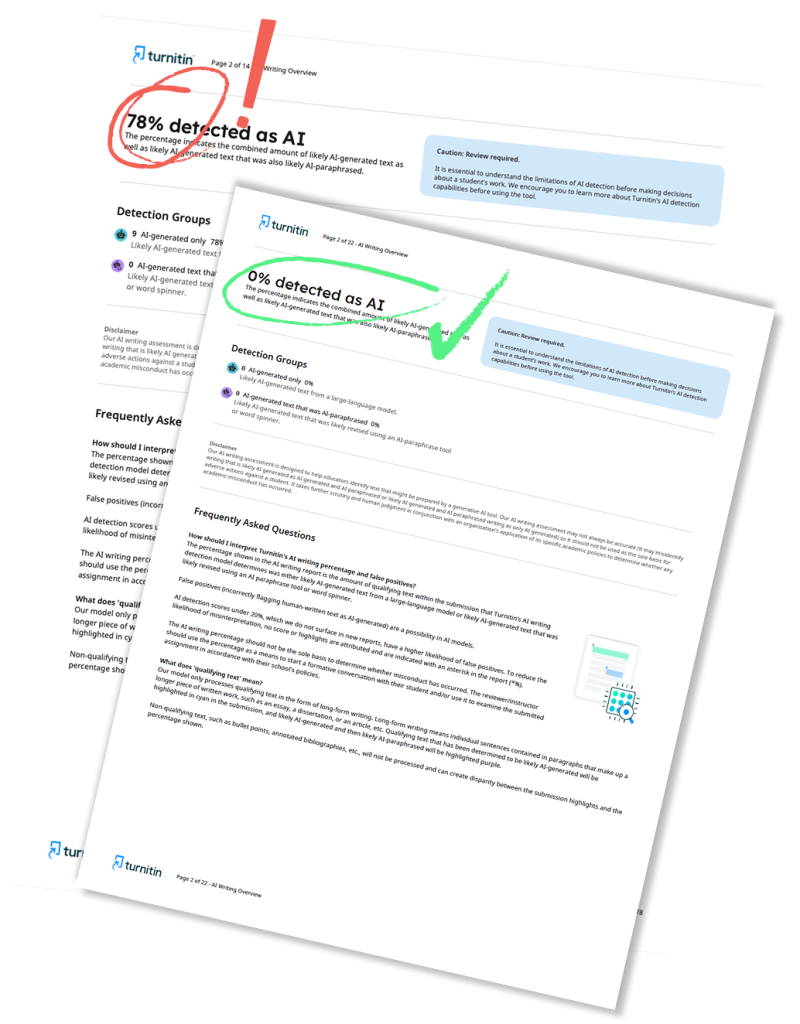
Here’s the catch: students cannot see their own AI detection scores. Turnitin designed this feature exclusively for instructors and administrators. Even if your school has purchased the AI detection add-on, you will only see your similarity score, not the AI percentage. Your professor sees both.
Can ChatGPT Be Detected by Turnitin?
Yes, Turnitin can detect ChatGPT-generated content in many cases. Independent testing from 2024 and 2025 shows detection rates between 90% and 95% on unedited GPT-4 output. Turnitin itself claims 98% accuracy with a sub-1% false positive rate on documents containing over 20% AI-generated text.
However, the tool isn’t perfect. Heavily edited AI text, hybrid documents blending human and AI writing, and content from non-native English speakers all create complications. A 2023 Stanford study found that AI detectors falsely flagged 61% of essays written by non-native English students as AI-generated. That bias remains a live concern.
Does Turnitin Detect AI Less Than 20%?
Turnitin handles low AI percentages differently. If its model detects between 1% and 19% of your text as AI-generated, it displays an asterisk with no specific percentage. The company made this change specifically because false positives spike in that range. Scores between 0% and 19% are considered less reliable and get treated cautiously.
Is It Possible for Turnitin to Show 100% AI and Be Wrong?
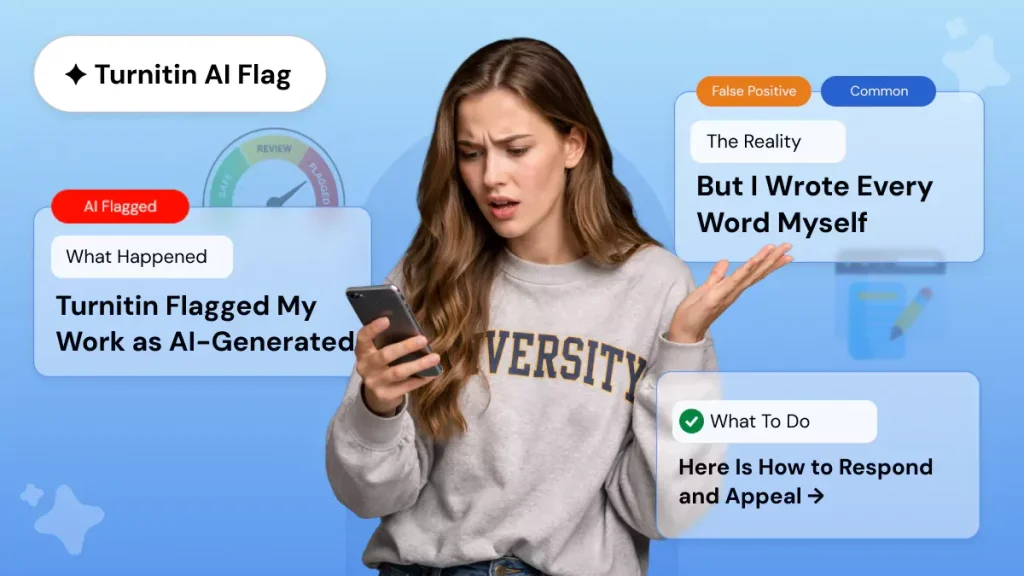
Absolutely. False positives happen. Human writing can trigger AI flags, particularly when it follows predictable academic structures or uses formulaic language. Some instructors have reported that essays written years before ChatGPT existed now show AI detection scores. If you wrote the paper yourself and get flagged, gather evidence of your writing process. Drafts, outlines, timestamps from Google Docs, and browser history can all help demonstrate that the work is yours.
Official Turnitin Documentation:
For a comprehensive understanding of how similarity scores work and what they represent, refer to the official Turnitin guide: Understanding the similarity score for students.
Turnitin AI Checker for Students: Your Realistic Options
Let’s address the search for a “Turnitin AI checker for students free.” No legitimate free version of Turnitin exists for individual users. Any website claiming to offer one is either a scam or an unauthorized third-party service using questionable methods.
If your school lacks Turnitin access, you have a few paths forward:
- Ask your instructor directly. Some professors will run a draft through Turnitin for you if you ask early.
- Visit your writing center. Many university writing centers can generate a similarity report during a tutoring session.
- Use reputable alternatives. Tools like Grammarly, Copyleaks, and Scribbr offer plagiarism checking for individuals. They don’t match Turnitin’s database exactly, but they catch obvious issues.
Some third-party services now sell single Turnitin checks, typically priced between $5 and $20 per document. These services use institutional accounts with “no repository” settings enabled, meaning your paper won’t get stored in Turnitin’s database and won’t trigger a self-match later. If you go this route, research the provider carefully. Avoid any service that asks for your university credentials or seems unwilling to explain how they process your document.
Keeping Your Work Original
At the end of the day, the best defense against both similarity flags and AI detection concerns is writing that is actually your own. Paraphrase ideas into your own words, cite every source properly, and resist the temptation to copy-paste from ChatGPT even if you plan to “rewrite it enough.” Turnitin’s algorithms improve constantly, and the gap between detection capabilities and evasion tactics keeps shrinking.
If you want to check your essay before submission, start with your institution’s resources. Contact your instructor, visit your writing center, or check whether your library offers plagiarism checking tools. These legitimate channels give you useful feedback without the risks that come with unofficial third-party services.
Worried about plagiarism scores or AI detection flags? Get the exact same plagiarism & AI report your professor sees in 15-20 minutes. Trusted by thousands of students, researchers, institutions, and agencies.