

Learn how human-written essays consistently clear Turnitin AI detection. Learn what scores like 20% mean and how to keep your reports clean.
The Reality of Turnitin AI Detection and Similarity Checks
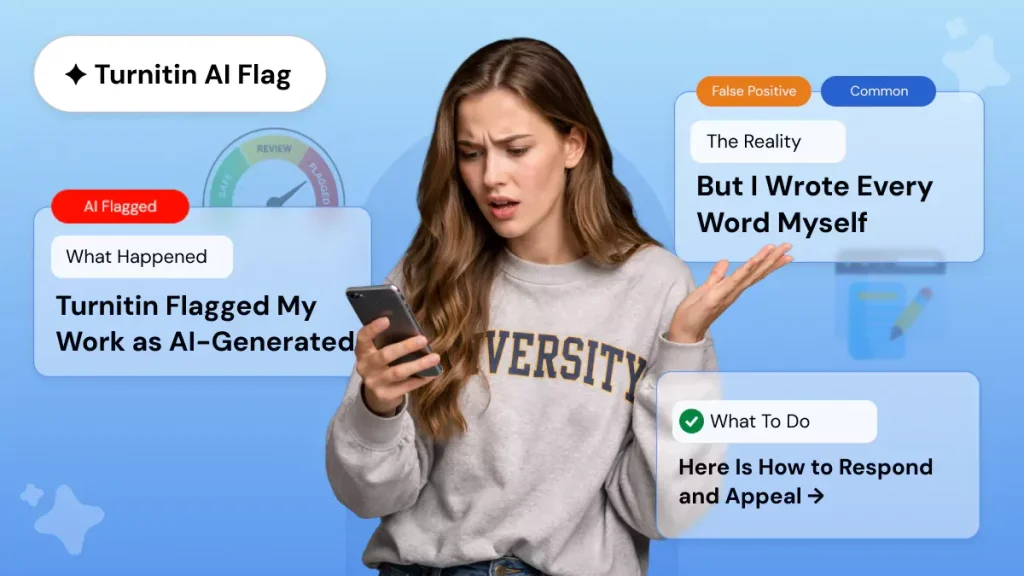
You finish writing a long paper, click submit, and wait for the results of the software scan. This scenario happens thousands of times every single day. Students want human-written essays that pass Turnitin AI detection every time, but achieving this goal requires a real understanding of how modern plagiarism and AI checkers operate. Professors rely heavily on a standard Turnitin check to police academic integrity. However, the system is not perfect. Innocent students often get flagged because of generic phrasing or common sentence structures. If you want to maintain your academic standing, you need to understand how Turnitin analyzes text and what your final percentage actually represents.

Check your essay before you submit. See exactly what your professor sees.
Get the exact same Turnitin report your professor uses. Join 50,000+ students who submitted their essays with confidence this semester.
When you submit a paper, the system runs two distinct evaluations. First, it performs a classic Turnitin scan to match your sentences against a database of billions of web pages, journals, and past student submissions. Second, it applies Turnitin AI detection algorithms to predict if a machine generated your text. Turnitin for students can be a helpful self-check tool, but it also creates widespread anxiety about hitting the wrong percentage threshold.
Many people wonder, can Turnitin detect ChatGPT? The answer is yes. It identifies the predictable patterns, high predictability, and uniform sentence lengths that AI platforms produce. Machine text relies on statistical probabilities, meaning it always selects the most likely next word. Human writers do not work that way. We use irregular structures, conversational shifts, and occasionally messy phrasing. Because of this structural difference, true human writing naturally bypasses the algorithmic filters.
Deciphering Your Score: What the Percentages Mean
Students frequently stress over specific numbers on their feedback reports. Let us look at the facts behind these numbers. Turnitin recently updated its system so that any AI metric under 20% shows up as an asterisk rather than a definitive number. The company did this because its data showed a higher rate of false positives in lower ranges. You might ask yourself, is 20% AI detection bad? In most cases, no. Faculty members know that common introductory phrases or heavy use of technical terminology can trigger a minor match. If you see a low score, it usually means your text contains standard academic phrases.
Let us break down how specific scores affect your academic evaluation in the table below.
Turnitin Score Interpretation Table
| Score Range | Context Type | Is it Bad? | Action Needed |
|---|---|---|---|
| 0% | AI or Similarity | Is a 0% Turnitin score good? Yes, but it might look suspicious if the paper contains complex technical research. | None, but verify citations are present. |
| 20% – 24% | AI or Similarity | Is 20% on Turnitin okay? Yes, this is standard. Is a 22% Turnitin score bad? No. Is 23% on Turnitin bad? Not at all. | Double-check that your direct quotes use proper formatting. |
| 25% – 34% | AI or Similarity | Is 25% on Turnitin too high? It depends on your school policy. Is a 33% Turnitin score bad? It warrants a closer look. | Review your paragraphs for heavy paraphrasing without fresh insights. |
| 35% – 49% | AI or Similarity | Is 35% Turnitin high? Yes, it is getting high. Is 42 a bad Turnitin score? Yes, this usually signals an issue. | Rewrite sections that lean too heavily on a single source. |
What is an alarming Turnitin score? Generally, any similarity or AI score that passes the 25% mark will trigger a manual review by your instructor. When a score hits 35% or 42%, the professor will actively investigate the paper to see if you copied material directly from another student or an online database.
Why True Human Writing Disarms Detection Systems
Artificial intelligence creates text based on mathematical modeling. Large language models calculate the next word by choosing the most statistically probable option. This results in text with very high predictability and uniform sentence lengths. If you write an essay using your own natural voice, you naturally avoid these traps. Human-written essays pass Turnitin AI detection every time because they contain natural flaws, varied vocabulary, and complex transitions.
When you sit down to write an assignment, your thought process is non-linear. You might use a short sentence to make a point. Then, you might follow it with a long sentence that connects three separate ideas using semicolons. This natural variation completely scrambles the detection algorithms. Turnitin AI detection looks for high perplexity and burstiness. Perplexity measures how predictable the words are, while burstiness measures the variation in sentence lengths. AI has low burstiness because its sentences are uniform. Humans have high burstiness because our writing style shifts constantly.
Can Turnitin Detect Copy and Paste vs. Paraphrasing?
Many students try to bypass the system by altering a few words in a copied paragraph. This tactic rarely succeeds. Can Turnitin detect copy and paste? Absolutely. The software easily flags exact word matches across consecutive strings of text.
But what about more advanced changes? Can Turnitin detect paraphrasing? Yes, the platform uses advanced natural language processing to spot when a writer simply swaps words for synonyms while keeping the original sentence structure intact. This is exactly why automated word spinners often fail. They retain the exact algorithmic rhythm of the original source, which the Turnitin scan catches instantly.
Sometimes, the system flags human writing incorrectly. Can Turnitin be wrong? Yes, it can. False positives occur when a human writer naturally uses formal, highly structured prose that matches the data patterns the software associates with AI. If your professor confronts you with an unfair score, you can defend your work by showing your Google Docs edit history or Microsoft Word version logs to prove your authentic writing process.
How to Pass Turnitin AI Check and Lower Your Score
If you want to know how to get a 0% on Turnitin or simply how to lower Turnitin score metrics, you must shift your writing style away from generic, predictable patterns. True human-written essays that pass Turnitin AI detection every time rely on specific structural choices that algorithms cannot replicate.
Here are the best strategies to handle a Turnitin check successfully:
- Inject Personal Voice and Anecdotes: Machine models do not have personal lives. Include specific examples from your own observations or classroom discussions. This breaks the predictable pattern of the text.
- Vary Your Sentence Lengths: Mix short, punchy statements with longer, complex thoughts. AI tends to generate sentences that are all roughly the same length. Humans change their rhythm based on emphasis.
- Avoid Overusing Passive Voice: Write with active verbs. Instead of saying “The experiment was conducted by the team,” say “Our team conducted the experiment.” Active voice alters the stylistic signature that AI detectors flag.
- Do Real Research and Source Synthesis: Avoid summarizing a single article. Compare three different sources in a single paragraph. When you piece together ideas from different authors, your sentence logic becomes too complex for an AI detector to mistake for machine text.
By implementing these steps, you learn how to pass Turnitin AI check protocols without relying on sketchy bypass software that might get you caught. Platforms like humanfyai.com focus on maintaining the natural flow of human language, which remains the best protection against algorithmic flags.
Official Turnitin Documentation:
For a thorough overview of how AI metrics are calculated, refer to the official support guides: ‘Using the AI Writing Report’.
Frequently Asked Questions About Turnitin Check Protocols
Can Turnitin detect copy and paste text from websites?
Yes, the software excels at tracking down text copied directly from online sources, digital textbooks, and academic journals. It highlights the exact matching phrases and provides a direct link to the original source website.
Can Turnitin detect paraphrasing tools like QuillBot?
Yes, the platform has updated its AI writing detection model to identify text altered by popular word spinners and paraphrasing tools. It catches the underlying sentence patterns and flags them as AI-paraphrased text.
Can Turnitin be wrong about AI usage?
Yes, false positives occur because academic writing often requires formal language, which can resemble the structured patterns of machine learning models. Turnitin admits that its AI detector is an advisory tool and should not be used as the sole basis for grading or discipline.
How can I get a 0% on Turnitin for AI detection?
To get a 0% score, you must write your entire assignment manually without using generative AI tools for drafting. Focus on sharing original thoughts, using varied sentence structures, and including specific personal insights.
Worried about plagiarism scores or AI detection flags? Get the exact same plagiarism & AI report your professor sees in 15-20 minutes. Trusted by thousands of students, researchers, institutions, and agencies.