

Get answers to all your Turnitin AI detection questions. Learn how Turnitin checks for AI content, what scores mean, and how to avoid false flags.
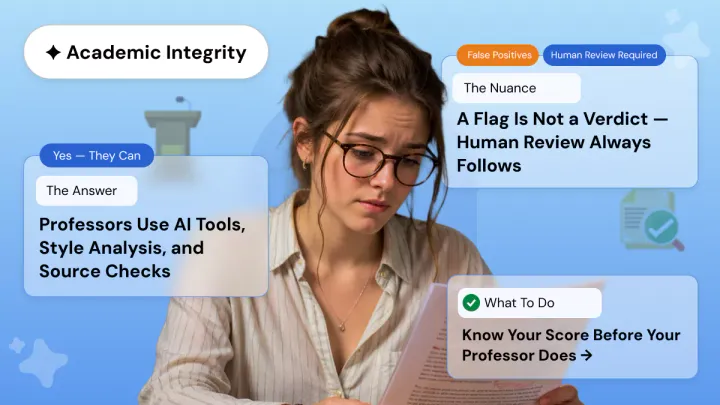
Turnitin AI detection has become a standard feature in academic writing since its launch in April 2023. If you are a student or educator, you have probably heard about it, read conflicting information online, or felt uncertain about what those percentage scores actually mean. This guide breaks down everything you need to know about how Turnitin checks for AI-generated content, how accurate it really is, and what you should do if your paper gets flagged.

Check your essay before you submit. See exactly what your professor sees.
Get the exact same Turnitin report your professor uses. Join 50,000+ students who submitted their essays with confidence this semester.
How Turnitin AI Detection Works
Unlike traditional plagiarism detection, which compares your text against existing sources, Turnitin AI detection works by analyzing writing patterns at the sentence level. The system evaluates how predictable your word choices are and how much variation exists in your sentence structure. AI-generated text tends to have low perplexity, meaning the next word is highly predictable, and low burstiness, meaning sentences follow a uniform rhythm. Human writing, by contrast, is messier. We write short sentences after long ones. We repeat ourselves. We start paragraphs with “So” or “But.” These inconsistencies are exactly what Turnitin looks for when deciding what counts as human.
What Turnitin Actually Looks For
The detection process follows three main steps. First, text extraction separates your original prose from quotations, references, and passages already flagged for similarity. Only your own writing moves forward for analysis. Second, pattern analysis evaluates each sentence’s predictability, measuring how closely your word choices resemble the output distribution of AI language models. Third, score assignment calculates what percentage of your analyzed text meets the threshold for likely AI-generated content.
The Difference Between a Turnitin Scan and Similarity Check
A Turnitin scan and a similarity check are two completely different processes that happen side by side. Your similarity score tells you how much of your paper matches existing sources in Turnitin’s database. Your AI detection score tells you how much of your writing displays patterns consistent with AI-generated text. A paper can have zero similarity matches and still show a high AI percentage. The reverse is also true. The two scores do not influence each other, and neither one automatically means you have done something wrong.
Understanding Your Turnitin AI Detection Score
When you submit a document, Turnitin breaks your text into segments of roughly five to ten sentences and scores each segment independently. The final AI percentage represents the proportion of your document that the model identifies as likely AI-generated with at least 98 percent confidence. Scores between 0 and 19 percent are marked with an asterisk and treated as uncertain. Scores of 20 percent or higher are considered statistically meaningful and may prompt further review by your instructor or institution.
Can Turnitin Make Mistakes?
Yes, and the company admits this openly. False positives happen, particularly with certain types of human writing. Highly formulaic academic prose, standardized methodology sections, and certain non-native English writing patterns have all been flagged incorrectly. Research from Temple University found that Turnitin correctly identified fully human-written text about 93 percent of the time, but accuracy dropped when humans edited AI-generated drafts or when AI text was run through paraphrasing tools. The takeaway here is that the AI score is an indicator, not a verdict. No responsible institution should treat it as proof of misconduct on its own.
Turnitin for Students: What You Need to Know
If you are a student, you should understand that Turnitin for students typically hides the AI detection report from your view. Only instructors and administrators can access it. Some institutions may choose to share the report with you if there is a concern, but this varies by school policy. You should also know that Turnitin does not specify a maximum allowable limit for AI-generated content. The actual acceptance of AI-generated content is determined by each institution’s academic integrity policies, so consult your specific guidelines to understand what is permissible.
How to Avoid False AI Flags
If you want to reduce your chances of a false flag during a Turnitin check, there are practical steps you can take. Write with variation in your sentence length. Avoid overly polished, robotic transitions. Include specific examples, personal observations, or field-specific terminology that AI models are less likely to generate accurately. Most importantly, keep your drafts. Version history with timestamps, outline notes, and annotated sources are the best defense if you ever need to demonstrate your writing process.
For a deeper understanding of how Turnitin processes your submission and interprets results, refer to the official Turnitin documentation on . This resource explains how to read the color-coded highlights and what differentiates AI-generated text from AI-paraphrased text in your report.using the AI Writing Report
Frequently Asked Questions
Does Turnitin detect all AI writing tools?
Turnitin detects content from major language models including GPT-3.5, GPT-4, GPT-4o, Claude, and Google Gemini. It also flags text that has been processed through AI paraphrasing tools like QuillBot since mid-2024. However, no detector catches everything. Turnitin itself acknowledges that roughly 15 percent of AI-written text may go undetected.
Can I see my own AI detection score?
In most cases, no. Turnitin for students typically hides the AI detection report from student view. Only instructors and administrators can access it. Some institutions may choose to share the report with you if there is a concern, but this varies by school policy.
What is the difference between AI-generated and AI-paraphrased text in my report?
AI-generated text refers to content that appears to have been written directly by an AI model. AI-paraphrased text refers to content that was AI-generated and then modified using an AI paraphrasing or humanization tool. Turnitin uses cyan highlights for AI-generated text and purple highlights for AI-paraphrased text.
Will quoting sources or using references increase my AI score?
No. Quotations and reference lists are generally excluded from the analysis. Turnitin focuses on original prose, so properly cited quotes should not affect your AI detection percentage. That said, if your entire paper consists of templated or boilerplate language, the pattern could still raise flags.
Can I resubmit my paper to get a different AI score?
Your AI score will remain the same for a given submission unless your institution resubmits it or you submit a new version of the document. Turnitin does not retroactively update existing reports when its model improves. Only new submissions receive the updated analysis.
Is using an AI humanizer tool a good way to avoid detection?
No. Turnitin has actively built detection capabilities for AI bypasser tools, and updates released in August 2025 specifically target content that has been processed through humanizers. These tools also carry privacy risks. Many free AI humanizers collect and reuse your text for training their own models, which creates serious academic integrity concerns.
What should I do if my paper is falsely flagged as AI-generated?
Gather evidence of your writing process. This includes dated drafts, revision history, brainstorming notes, and any correspondence with peers or advisors about your work. Share this with your instructor and ask for a human review of the flagged sections. Remember, the AI score is meant to start a conversation, not end one.
Worried about plagiarism scores or AI detection flags? Get the exact same plagiarism & AI report your professor sees in 15-20 minutes. Trusted by thousands of students, researchers, institutions, and agencies.