

Learn how to run a plagiarism and AI check in the USA without institutional access, interpret similarity scores, and understand AI detection before your final submission.
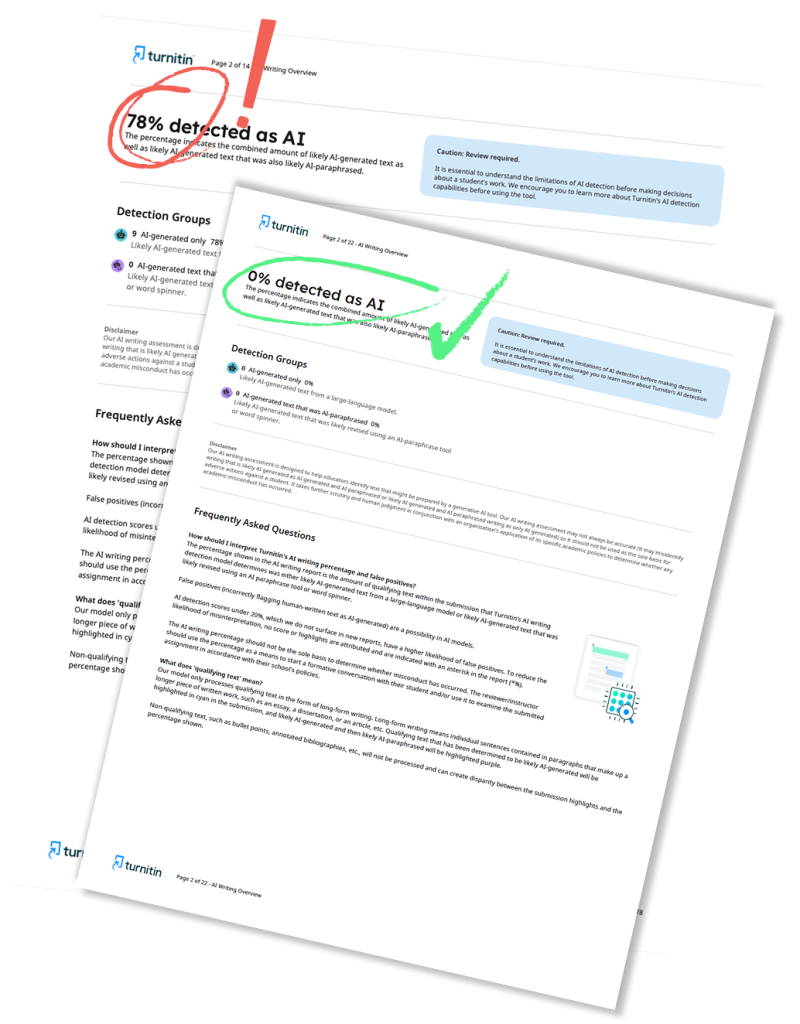
SUMMARY: Turnitin is the most widely used academic integrity tool in U.S. higher education, scanning submitted documents against billions of web pages, journal articles, and student papers to generate similarity reports. Because Turnitin licenses are sold only to institutions, students without school access cannot obtain reports directly through official channels.

Check your essay before you submit. See exactly what your professor sees.
Get the exact same Turnitin report your professor uses. Join 50,000+ students who submitted their essays with confidence this semester.
Third-party services offer an alternative by processing documents through authorized accounts and returning both similarity and AI detection reports. Understanding how to interpret these results, including color-coded scores and AI writing indicators, helps students identify and correct potential issues before final submission.
A Turnitin check is the standard most American professors expect when you hand in an essay, research paper, or thesis. If you attend a U.S. university, chances are your submission runs through this system before your instructor ever reads a word. The software compares your writing against an enormous database of published journal articles, archived web pages, and previously submitted student papers. According to 2025 data, Turnitin now operates across 17,000 institutions and reaches 71 million students globally, making it the most widely used academic integrity tool in higher education. For many students, though, getting access poses a real problem. Turnitin sells licenses exclusively to schools and universities, not to individuals. If your institution lacks a subscription, or if you want to preview your results before the final deadline, you need another route. Services like humanfyai.com bridge that gap by delivering genuine Turnitin similarity reports and AI detection results directly to students and researchers who lack institutional portals.
How a Turnitin Scan Actually Works
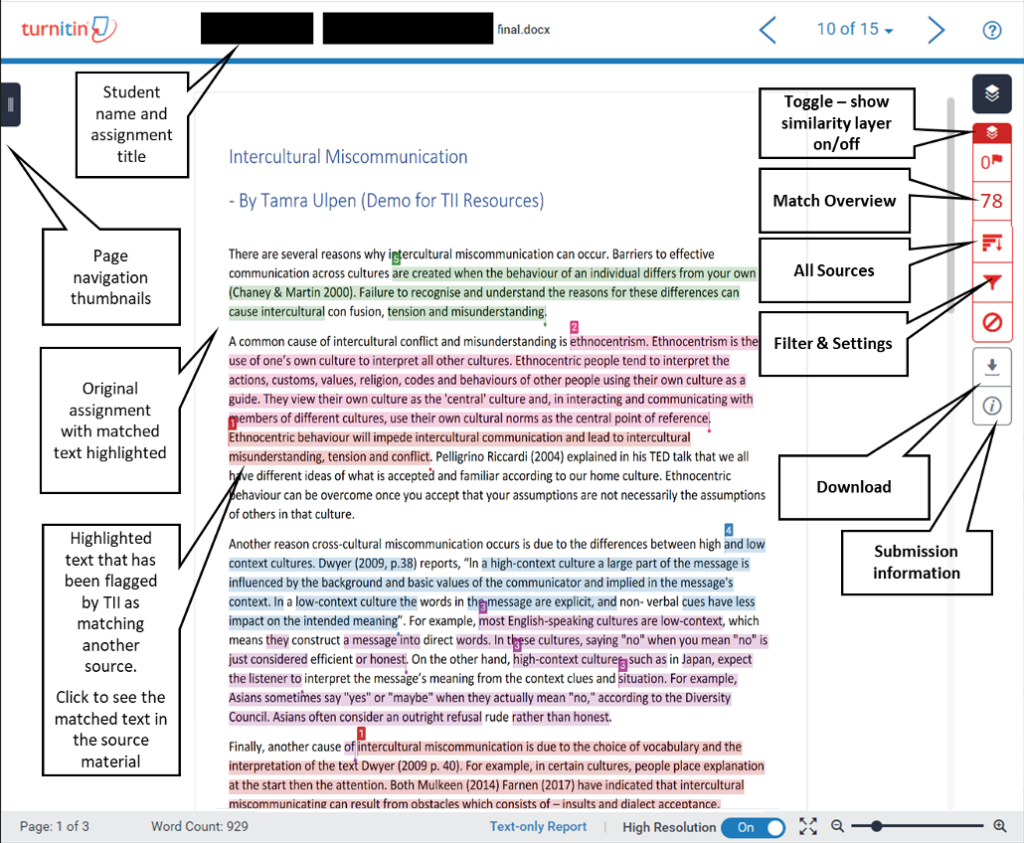
When you upload a document for a Turnitin scan, the system breaks your text into small alphanumeric strings and searches for matches across multiple repositories. These include billions of current and archived web pages, academic journals, and student papers previously submitted to Turnitin from universities across the globe. The comparison happens in real time, and within minutes the software generates a Similarity Report that highlights any text matching external sources. This report does not label you a plagiarist. It simply shows percentages and color-coded matches so your instructor can review the context and decide if citations are adequate.
Reading the Color-Coded Scores
The similarity score uses a color scale that quickly signals the extent of matching text. Blue means no matches. Green indicates a match between one word and 24 percent. Yellow covers 25 to 49 percent, orange spans 50 to 74 percent, and red means 75 to 100 percent. A high percentage does not automatically mean you cheated. If your paper relies heavily on quoted legal statutes or scientific methodology descriptions, those sections inflate the score through no fault of your own. Professors look at the specific sources rather than obsessing over the raw number. Still, running your own Turnitin scan beforehand helps you spot accidental matches you might have missed, such as forgotten quotation marks or paraphrasing that sits too close to the original wording.
Turnitin for Students: Access Challenges and Solutions
Most Turnitin for students access happens through institutional learning management systems like Canvas, Blackboard, or Moodle. Your professor creates an assignment, enables the originality check, and you submit your file directly through that portal. If your school pays for the AI detection add-on, your instructor can also view an AI writing indicator that estimates how much of your document may have been generated by tools like ChatGPT, Claude, or Gemini. Turnitin launched this feature in April 2023 and has since processed over 200 million papers for AI detection. Company data shows that roughly 11 percent of submissions contain at least 20 percent AI-flagged content, while about 3 percent show 80 percent or more AI-generated text.
The catch is that students cannot purchase Turnitin directly. The company explicitly states that it does not offer individual licenses. If your school lacks a subscription, or if you graduated and no longer have LMS access, you are locked out of the official pipeline. Third-party services like humanfyai.com solve this by processing your document through authorized accounts and delivering the exact same similarity and Turnitin AI detection reports your professor sees, without storing your paper in any public repository.
Understanding Turnitin AI Detection in 2026
Turnitin AI detection has become a major concern for students since generative AI tools exploded into mainstream use. The detection model analyzes sentence-level patterns rather than comparing text against a database. It looks for predictability, uniformity in sentence structure, and statistical properties typical of machine-generated writing. The AI indicator appears alongside the similarity report, giving instructors a dual view of potential issues. Since January 2024, this feature requires the Turnitin Originality add-on, which institutions must license separately from the base similarity checking product.
The False Positive Problem
The system is not flawless. Independent research from Stanford University found that AI detectors flag over 61 percent of essays written by non-native English speakers as AI-generated, because simpler vocabulary and formulaic sentence structures overlap with patterns the model associates with machine text. At least 12 elite universities, including MIT, UCLA, and Vanderbilt, have deactivated the AI detection module entirely due to concerns about wrongful accusations. The results require human interpretation rather than blind acceptance.
Why Run Your Own Plagiarism and AI Check Before Submitting
Running a Turnitin check before your official submission gives you time to fix problems while you still have control. Maybe a direct quote lacks proper attribution. Maybe a paragraph you thought you paraphrased still mirrors the source too closely. Catching these issues early prevents uncomfortable conversations with professors and protects your academic record from integrity violations that could affect scholarships or graduation.
The process through humanfyai.com is straightforward. You upload your document in Word or PDF format, the team processes it through certified Turnitin algorithms, and you receive both a similarity report and an AI detection analysis within 15 to 20 minutes. Your document gets deleted after processing, so no trace remains in any institutional database. For students at schools without Turnitin subscriptions, international scholars applying to American programs, or researchers preparing manuscripts, this offers a practical way to verify originality without jumping through institutional hoops.
Official Turnitin Documentation:
For a comprehensive explanation of how similarity scores work and what the colors mean, refer to Turnitin’s official guide: Understanding the similarity score.
Similarity Checking vs. AI Detection
Students often confuse similarity checking with AI detection, but these are separate processes. Similarity checking compares your text against existing sources to find matches. AI detection evaluates writing style and linguistic patterns to estimate how much content may have been generated by a large language model. You can have zero similarity and still receive an AI flag if your writing style appears statistically uniform. Conversely, you can have a high similarity score from properly cited sources and receive no AI flag at all. Understanding both metrics helps you approach academic writing with the transparency that professors expect.
Practical Tips for Better Scores
No universal threshold defines an acceptable similarity score, since every institution sets its own expectations. That said, several practices help keep both your similarity and AI scores within reasonable bounds. Paraphrase thoroughly rather than swapping a few words. Use direct quotes sparingly and always wrap them in quotation marks with proper citations. Add your own analysis and conclusions rather than stacking source after source. If you use AI tools for brainstorming, rewrite the output completely rather than submitting lightly edited drafts. Vary your sentence length and structure, because uniform rhythm reads as machine-generated even when you wrote every word yourself. Finally, run your paper through a preliminary Turnitin scan using humanfyai.com to see exactly what your professor will see. Fixing issues before submission takes minutes. Explaining them after the fact takes considerably longer.
Worried about plagiarism scores or AI detection flags? Get the exact same plagiarism & AI report your professor sees in 15-20 minutes. Trusted by thousands of students, researchers, institutions, and agencies.