

See how the Turnitin plagiarism checker USA works. Learn how a Turnitin check handles AI detection, similarity scores, and student files.

SUMMARY: Turnitin is the primary plagiarism detection platform used by academic institutions across the United States to verify the originality of student submissions. It compares uploaded documents against internet archives, academic publications, and a global student paper repository, generating a similarity score based on matched text.

Check your essay before you submit. See exactly what your professor sees.
Get the exact same Turnitin report your professor uses. Join 50,000+ students who submitted their essays with confidence this semester.
The platform also includes an AI detection tool that analyzes writing patterns for characteristics of machine-generated content, measuring perplexity and burstiness rather than matching text to external sources. Students can access their similarity reports through learning management systems to identify citation errors before final submission.
Turnitin plagiarism checker USA
Academic institutions across the United States rely heavily on automated systems to maintain grading integrity and protect intellectual property. The Turnitin plagiarism checker USA platform functions as the standard infrastructure for universities, colleges, and high schools seeking to verify the originality of written assignments. When you submit a paper through your university learning management system, the software breaks down your text into smaller strings of data to compare them against a massive archive of digital content. This process does not merely look for exact matches; it uses advanced text-matching algorithms to recognize structural similarities, patterns, and modified phrasing.
The widespread adoption of this system creates a specific standard for academic writing in the United States. Professors use these reports to make objective determinations about academic misconduct, which means understanding how the software processes your paper is necessary for academic success. Because universities configure their software settings individually, a similarity threshold that passes at one college might trigger a manual review at another. The system scans millions of papers daily, adding every new submission to its repository, which constantly expands the baseline for future comparisons.
Colleges use automated checking platforms to establish a uniform baseline for all students. Instead of relying on a professor to remember every article they have ever read, the software acts as an impartial auditor. This creates an environment where original research and proper citation practices are the only ways to guarantee a passing grade. If you use external sources without proper attribution, the system will identify the source repository instantly, highlighting the exact passages you copied or closely paraphrased.
Every time you upload a document for a Turnitin scan, the system executes a series of multi-layered database comparisons. The software processes the document text by stripping out special formatting and analyzing the linguistic DNA of your sentences. It checks your phrases against three main database segments: active and archived internet web pages, professional periodicals and journals, and millions of previously submitted student papers.
The software generates a percentage score based on the total number of matching words divided by the overall word count of your paper. For example, if your essay contains 1,000 words and the system flags 150 words as matching external sources, your similarity score will read as 15%. This percentage does not automatically prove plagiarism, because the system highlights properly cited quotes, bibliographies, and common disciplinary terminology. Professors must manually inspect the generated report to differentiate between a student using legitimate block quotes and a student attempting to pass off unoriginal text as their own work.
To understand how your paper is evaluated, you need to look at what the scanner checks your document against. The internet database includes billions of pages of current and historical web content, meaning that blog posts, news articles, and public forums are all searchable. The publication database contains millions of pages from thousands of academic journals, books, and encyclopedias, which are often behind paywalls but remain accessible to Turnitin. Finally, the student paper repository includes submissions from thousands of universities across the United States, meaning you cannot reuse a paper that your friend turned in at a different college three years ago.
| Database Type | Scope of Content Checked | Primary Match Risk for Students |
| Internet Archive | Billions of active and cached web pages | Unattributed copying from blogs, wikis, and news sites |
| Academic Publications | Journals, periodicals, books, and encyclopedias | Failing to cite medical, legal, or scientific literature |
| Student Repository | Submissions from global and USA universities | Recycling older assignments or sharing papers among peers |
The rise of generative artificial intelligence has changed how educators review student submissions. The integrated Turnitin AI detection engine operates alongside the traditional similarity scanner to evaluate if a text was generated by tools like ChatGPT, Claude, or Gemini. This specific tool does not look for matching text on the internet; instead, it analyzes the predictability of your writing style. AI language models write by predicting the most probable next word in a sentence, which results in highly structured, consistent, and uniform language patterns.
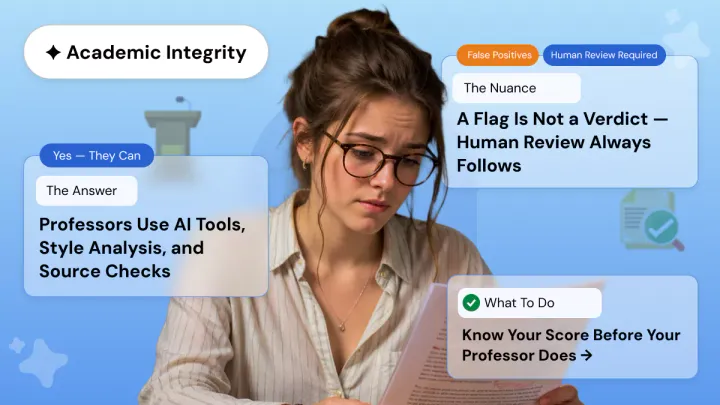
The AI detector assigns a separate percentage score indicating how much of the document shows characteristics of machine generation. If your text lacks conversational variation, uses overly repetitive sentence structures, or maintains a perfectly uniform rhythm, the detector flags those sections. The system has updated its capabilities to identify text that has passed through various paraphrasing tools, making it harder to bypass the check by simply replacing words with synonyms.
Human writers naturally display cognitive variance, meaning they switch sentence lengths, use idiosyncratic punctuation, and transition between ideas in slightly unpredictable ways. The automated detector looks for perplexity and burstiness in your writing. Perplexity measures how surprising a word choice is to the algorithm, while burstiness measures the variation in sentence length and structure. Machine-written papers have low perplexity and low burstiness, which signals to the algorithm that an AI model likely created the text.
Understanding the platform from the student perspective helps you avoid accidental academic violations. Most universities provide access to Turnitin for students through portals like Canvas, Blackboard, or Moodle, allowing you to see your feedback studio dashboard. Depending on the settings selected by your instructor, you may be able to view your similarity report immediately after uploading your draft, giving you a chance to fix citation mistakes before the final grading deadline.
When you open the feedback studio, you will see your paper with various color-coded highlights. Each color corresponds to a specific source type or match group, helping you trace exactly where the text overlaps with an existing document. If you notice large blocks of highlighted text, you must convert those sections into your own words or apply proper quotation marks and in-text citations.
The system categorizes your overall similarity score into five distinct color tiers to give professors a quick visual indicator of potential issues.
- Blue: 0% matching words, indicating completely original text or a document under the word minimum.
- Green: 1% to 24% matching words, which is typical for standard research papers containing citations.
- Yellow: 25% to 49% matching words, often requiring a closer look by the instructor to check citation volume.
- Orange: 50% to 74% matching words, indicating that half the paper relies on external text structures.
- Red: 75% to 100% matching words, signaling that the document is almost entirely unoriginal.
Official Turnitin Documentation: For a comprehensive breakdown of how scores are calculated and what they mean, refer to the official student support guides: Interpreting the similarity score.
Running a preliminary Turnitin check before your professor sees your final draft is an effective way to maintain academic integrity. Many students make honest mistakes, like forgetting a closing quotation mark or omitting a source from the bibliography. By reviewing a preliminary scan, you can identify these technical errors and correct them in your own time, avoiding stressful conversations with academic boards.
To get the most out of your pre-submission check, pay close attention to the specific phrases highlighted within your text. If the system flags a common phrase or a standard definitions sequence, you can usually leave it alone, as instructors understand that certain technical terms have limited variations. However, if the software flags entire consecutive sentences, you should rewrite those passages completely to make certain that your own voice dominates the narrative. Relying on your critical analysis rather than repeating source material guarantees that your final grade reflects your actual understanding of the assignment subject.
Worried about plagiarism scores or AI detection flags? Get the exact same plagiarism & AI report your professor sees in 15-20 minutes. Trusted by thousands of students, researchers, institutions, and agencies.