

Why is your Turnitin score so high? Learn what similarity scores mean, how Turnitin for students works, and how to lower Turnitin score before submission.
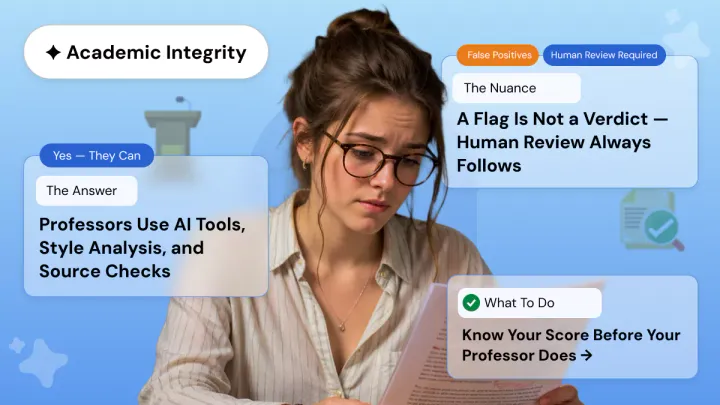
SUMMARY: Turnitin similarity scores measure textual overlap, not plagiarism, and high percentages often result from properly cited quotes, bibliographies, and common academic phrases rather than misconduct. Scores below 25% are generally acceptable, while scores above 50% typically require revision.

Check your essay before you submit. See exactly what your professor sees.
Get the exact same Turnitin report your professor uses. Join 50,000+ students who submitted their essays with confidence this semester.
Professors review the full Match Overview report rather than the percentage alone, focusing on whether flagged passages are cited and whether any single source dominates the matches. Students can lower their scores by paraphrasing properly, reducing direct quotations, and ensuring complete citations throughout their work.
Why Is My Turnitin Score So High? What the Number Actually Means
You submitted your paper, ran a Turnitin check, and now you are staring at a percentage that looks alarming. Maybe it is 30%, maybe it is 55%, or maybe it hit 70% and your stomach dropped. Before you panic, understand this: that number does not mean you plagiarized that percentage of your paper. A Turnitin scan measures textual overlap, not academic misconduct. It flags matching text, but it cannot judge intent, proper citation, or context. Your job is to read the report, understand what is driving the match, and fix what actually needs fixing.
Most students encounter high similarity scores for reasons unrelated to cheating. Your bibliography alone can add 5% to 10% because every formatted citation matches identical citations in thousands of other papers. Direct quotes that you properly cited still register as matches. Common academic phrases like “the results suggest that” appear in millions of published works and trigger small flags. Even your own previous drafts can match against your final paper. These are normal outcomes of using sources responsibly.
How Turnitin Calculates Your Similarity Score
When you submit a document, Turnitin compares it against billions of web pages, archived internet content, academic journals, and previously submitted student papers. The system highlights any sequence of words that matches existing text and expresses the total as a percentage of your word count. That is your similarity score.
The score does not distinguish between a properly cited direct quote and a paragraph copied without attribution. It treats your reference list the same way it treats stolen text. This is why professors review the full report rather than glancing at the number. The breakdown of sources matters far more than the total percentage. A paper with 20% similarity spread across 15 sources at 1% to 2% each is typically fine. A paper with 18% similarity where 12% comes from a single uncited website is a problem.
What Is an OK Percentage on Turnitin?
There is no universal cutoff. Most universities flag papers above 20% to 25% for manual review, while scores below that rarely trigger scrutiny.
A score between 5% and 15% reflects normal academic writing. Standard phrases and citation formats generate enough background noise to land almost any honest paper in this range. Scores from 15% to 25% warrant a closer look but are often acceptable if the matches come from quotes, references, or distributed small phrases. Scores above 25% draw serious attention, and anything above 50% almost always requires revision.
Is 25% on Turnitin Too High? Is a 24% Turnitin Score Bad?
Not automatically. A 25% Turnitin score or a 24% Turnitin score sits at the boundary where many institutions switch from green to yellow. If that percentage consists of properly cited quotations, a lengthy bibliography, and scattered common phrases, most instructors will not bat an eye. Literature reviews and legal writing papers often land here because quoting source material is built into the assignment. Check the Match Overview in your report. If no single source accounts for more than 3% to 4% of the total, and every highlighted passage has a citation attached, you probably have nothing to worry about. A well-cited paper at 24% or 25% is far safer than a poorly cited paper at 12%.
Is 60% on Turnitin Bad?
Yes, a 60% Turnitin score signals a significant problem. At this level, more than half your document matches existing sources. Even with legitimate explanations for some overlap, such as required quotations, a score this high indicates that too much of your paper relies on external text. Go through the report match by match, identify the largest overlaps, and rewrite those sections entirely. Close your sources, explain the ideas in your own words, and rebuild your arguments from scratch. Do not merely swap synonyms. Restructure sentences and inject your own analysis.
What Happens If You Get a High Turnitin Score?
The consequences depend on your institution and the assignment. Your professor will open the full report, review the flagged passages, and make a judgment call. If the matches come from properly cited quotes and bibliographic material, nothing happens. If the matches reveal uncited copying or poor paraphrasing, you might face outcomes ranging from a request to revise and resubmit, to a formal academic integrity investigation, to a failing grade. Repeat offenses carry heavier penalties, including suspension or expulsion.
Your best defense is preparation. Run a Turnitin check before your final submission if your school allows draft uploads. If not, services like humanfyai.com let you scan your document privately without adding it to any database. You get the same report your professor sees, giving you time to address problems while you can still fix them.
How to Lower Turnitin Score
If your report shows concentrated matching from a few sources, or large blocks of uncited flagged text, take action. The following steps will help you lower Turnitin score before resubmission:
- Paraphrase properly. Close the source and rewrite the idea in your own words. Change sentence structure, not only vocabulary.
- Reduce direct quotations. Limit quotes to essential passages. Summarize everything else, and always cite the source.
- Check your citation format. Incomplete or missing citations cause flags that proper attribution would prevent.
- Break up matches from single sources. If one source dominates your Match Overview, diversify your research.
- Exclude bibliography matches. Ask your instructor if bibliography exclusions are enabled for a more accurate score.
- Avoid AI paraphrasing tools. Turnitin AI detection flags text processed by tools like Quillbot, creating a separate set of problems.
Common Causes of High Scores (That Are Not Plagiarism)
Bibliographies and reference lists are the biggest culprit. A 30-source bibliography can add 5% to 10% because every citation format matches identical entries in other papers. Required direct quotes in legal analysis or literature essays register as matches even with perfect citations. Self-matching occurs when your own prior draft matches your final paper. Standard methodology language also produces matches because established procedures are described using the same conventions across thousands of published papers. Even phrases like “in recent years” trigger small flags because they appear constantly across scholarly writing.
Does Turnitin Detect AI Writing? Is Turnitin 100% Correct?
Yes, Turnitin AI detection analyzes writing patterns to estimate how much text was generated by AI tools like ChatGPT. It operates separately from the similarity score, showing a percentage of likely AI-generated text with cyan highlights for pure AI content and purple for AI-paraphrased text. Scores between 1% and 19% display an asterisk because false positives are common in that range. The system claims 98% accuracy under controlled conditions.
No, Turnitin is not 100% correct. It is a pattern-matching tool, not a plagiarism verdict machine. It can flag properly cited material, miss content from password-protected sites, and fail to detect sources not in its database. Its AI detection can misidentify human writing as AI-generated, particularly for non-native English speakers. Treat the report as feedback, not as a final ruling on your integrity.
Official Turnitin Documentation:
For a comprehensive guide on how similarity scores are calculated and what the color-coded ranges mean, refer to the official student support resource: Understanding the similarity score for students.
Bottom Line
Your Turnitin score is a diagnostic tool, not a grade on your character. A high number tells you where to look, not what to conclude. Review the Match Overview, check if flagged passages are cited, and fix areas where your writing relies too heavily on a single source. If you want certainty before submitting, run a private Turnitin scan through humanfyai.com and address any issues while you still have time. The goal is not a 0%. The goal is a paper that reflects your own thinking, supported by properly attributed sources, with a similarity breakdown that holds up under scrutiny.
Worried about plagiarism scores or AI detection flags? Get the exact same plagiarism & AI report your professor sees in 15-20 minutes. Trusted by thousands of students, researchers, institutions, and agencies.