

Can Turnitin detect ChatGPT? Learn how Turnitin AI detection works, what a Turnitin scan actually flags, and how to protect your academic integrity
Turnitin’s AI detection, launched in April 2023 and used across 16,000 institutions, identifies AI-generated text by analyzing statistical writing patterns rather than matching phrases to a database. It flags content from models including GPT-4, Gemini, and LLaMA, and can detect both raw AI output and text run through paraphrasing tools.
The system is not infallible. It struggles with mixed human-AI writing, produces higher false positive rates for non-native English speakers, and should not be used as sole evidence of misconduct. Students are advised to write original work, document their drafting process, and use AI tools only for brainstorming rather than generating submission-ready text.

Check your essay before you submit. See exactly what your professor sees.
Get the exact same Turnitin report your professor uses. Join 50,000+ students who submitted their essays with confidence this semester.
Can Turnitin Detect ChatGPT? What a Turnitin Check Actually Reveals
If you have ever stared at a blank document and felt the temptation to let ChatGPT do the heavy lifting, you are not alone. Millions of students now use AI writing tools, and schools have responded fast. Turnitin, the plagiarism detection platform used by over 16,000 institutions, rolled out its AI writing detection feature in April 2023. Since then, one question dominates every classroom: can a Turnitin check actually spot text generated by ChatGPT? The short answer is yes, and understanding how a Turnitin scan works will save you from serious academic trouble.
How Turnitin AI Detection Works
Turnitin does not hunt for specific phrases copied from ChatGPT. There is no master database of AI sentences. Instead, Turnitin AI detection uses a deep-learning model trained on millions of student submissions to recognize statistical writing patterns. The system breaks your paper into overlapping segments of roughly five to ten sentences, then scores each segment from 0 to 1. A score of 0 means the text looks human-written; a score of 1 means it likely came from an AI model.
The model analyzes what it calls “qualifying text,” which means prose paragraphs in essays and research papers. It skips bullet points, tables, code, and references. The final percentage in your Turnitin report represents the portion of qualifying text flagged as likely AI-generated. Turnitin claims a 98% confidence threshold before flagging content, which means the tool would rather miss some AI text than falsely accuse a student.
What AI Models Can Turnitin Flag?
Turnitin’s detection capabilities have expanded significantly since launch. The system now identifies content from GPT-3, GPT-3.5, GPT-4, GPT-4o, Google Gemini, and Meta’s LLaMA. Turnitin updates its model every three to four months. A paper that slipped through last semester might not pass a Turnitin scan today.
Can Turnitin Detect Copy and Paste from ChatGPT?
Yes. This is where most students get caught. When you copy and paste raw ChatGPT output directly into your submission, Turnitin AI detection flags it immediately. Raw ChatGPT text carries distinct statistical fingerprints: predictable sentence structures, consistent tone, and low variation in word choice. In testing by Johns Hopkins faculty, Turnitin correctly identified 100% AI-generated essays as entirely machine-written. Instructors see cyan highlighting over flagged sentences and a blue percentage score in the AI Writing Report.
Many students do not realize that the AI score and similarity score are completely separate systems. The similarity score checks if your text matches existing sources in Turnitin’s database. The AI detection score analyzes your writing style and structure. A completely original essay with zero plagiarism can still trigger a high AI flag if the writing patterns look machine-generated.
Will Turnitin Detect AI If I Reword It?
This is the question that keeps students up at night, and the answer frustrates anyone who thinks running ChatGPT output through a paraphrasing tool makes it invisible. Turnitin can detect AI-paraphrased text, and the company has been explicit about this. When you use tools like QuillBot, Turnitin’s secondary analysis model kicks in and looks for the telltale signs of AI content that was modified by another AI tool. The report marks this with purple highlighting.
Simple rewording fails because changing “consequently” to “as a result” only alters surface-level features. The deeper structural patterns, the statistical rhythm of how words flow together, remain intact. Independent testing at Temple University found that Turnitin correctly identified 63% of disguised AI texts, those run through paraphrasing tools, as containing AI content. Only deep, substantive human rewriting that adds personal analysis and original examples reliably drops the AI score.
Where Detection Gets Fuzzy
Turnitin struggles with hybrid texts where students mix their own writing with AI-generated passages. The same Temple study showed Turnitin correctly classified only 43% of these mixed texts. Sometimes it called them fully human; other times it flagged them as entirely AI. Many students use AI for brainstorming or outlining, then write the paper themselves. The detection model cannot draw clean lines in these scenarios.
What Turnitin for Students Actually Looks Like
Most institutions do not let students see the AI Writing Report directly. You typically see only the similarity score. Your instructor sees both reports side by side. The AI Writing Report uses color-coded highlighting: cyan for likely AI-generated text, purple for likely AI-paraphrased text, and blue with a percentage showing the overall AI proportion.
For submissions with less than 20% AI-detected text, Turnitin displays an asterisk instead of a number. The company acknowledges that low percentages carry higher false positive rates. Most instructors will not treat this as evidence of misconduct. Scores above 20% trigger more scrutiny, and scores above 50% often lead to formal academic integrity conversations.
Not every school has even activated AI detection. According to industry estimates, roughly 75% of U.S. universities use Turnitin, but only about 60% of those have turned on AI detection, and just 40% have formal policies about interpreting the scores. Your instructor might not check the AI report at all unless something else raises suspicion.
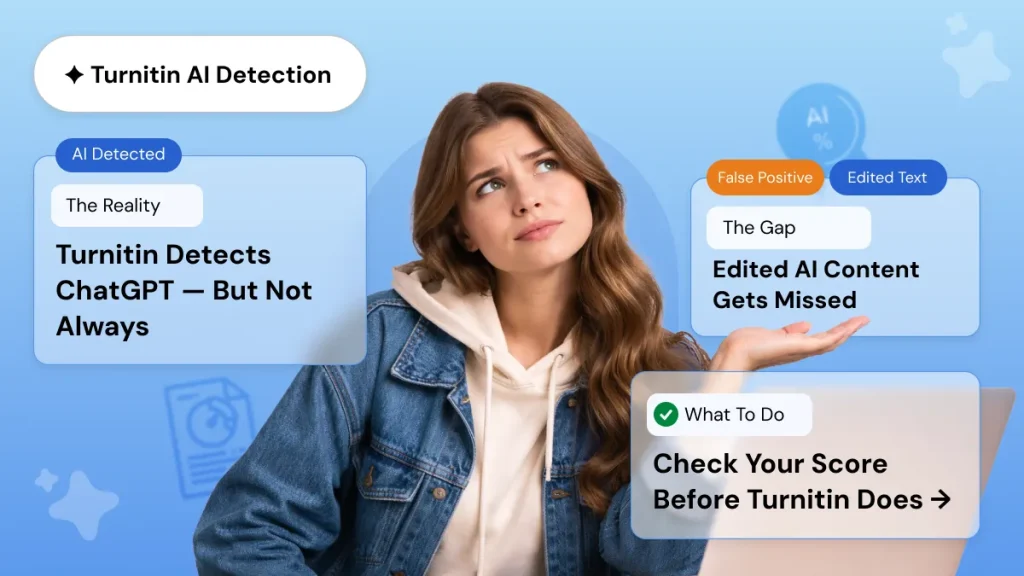
False Positives: When Human Writing Gets Flagged
AI detection sometimes accuses innocent students. Non-native English speakers face higher false positive rates because formal, structurally consistent writing, the kind you learn in ESL courses, shares statistical traits with AI text. A student writing in careful, grammatically precise English might trigger flags that a native speaker writing more casually would avoid.
Turnitin admits to roughly a 1% false positive rate. Independent testing suggests it runs higher, between 3% and 4% generally and up to 8% for ESL writers. Some instructors have reported that papers written years before ChatGPT existed have been flagged as AI-generated. Turnitin’s own documentation states that the AI score should never be used as the sole basis for disciplinary action.
If your original work gets flagged, stay calm. An AI score is statistical evidence, not proof. Gather your Google Docs version history, research notes, and drafts. Request a meeting with your instructor and walk through your writing process. Most universities require instructors to speak with students before escalating any academic integrity case.
Practical Tips for Staying Clear of Trouble
The simplest way to avoid a problematic Turnitin scan is to write your own work. Use AI tools for brainstorming or clarifying concepts, not for producing submission-ready text. If you borrow any AI-generated content, rewrite it thoroughly. Add personal examples, insert your own analytical voice, and vary your sentence structures intentionally. A genuine human rewrite changes not just the words but the logic and flow of the argument.
Keep your drafts and notes. Document your writing process as you go. This habit protects you if questions arise about authenticity. Before submitting major assignments, run your paper through your school’s pre-check system if one is available. A quick Turnitin check before the deadline gives you time to address any unexpected flags.
Bottom Line
A Turnitin check has become standard in academic life, and the AI detection component is here to stay. Turnitin can detect raw ChatGPT output with remarkable accuracy, and it catches much of the AI-paraphrased content students try to pass off as their own. The system is not perfect; it generates false positives, struggles with mixed human-AI texts, and requires human judgment to interpret correctly. The path forward is straightforward. Do your own writing, use AI responsibly, and remember that detection technology improves every few months. The only reliable way to pass a Turnitin scan is to submit work that is truly yours.
Official Turnitin Documentation:
For a comprehensive guide on interpreting AI detection results and understanding the system’s capabilities and limitations, refer to the official Turnitin support documentation: Using the AI Writing Report.
Worried about plagiarism scores or AI detection flags? Get the exact same plagiarism & AI report your professor sees in 15-20 minutes. Trusted by thousands of students, researchers, institutions, and agencies.