

Turnitin’s AI detector claims 98% accuracy, but false positives are real. Learn what your score means, when to worry, and how to protect yourself from wrongful flags.
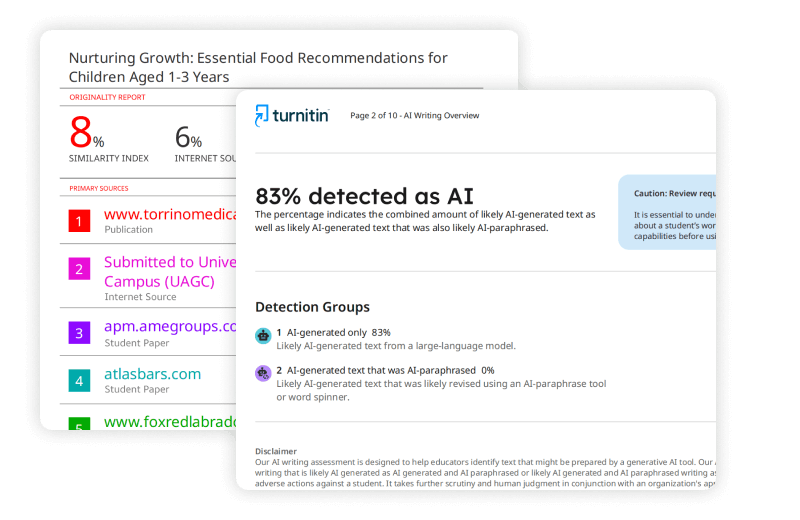
SUMMARY: Turnitin’s AI detection tool, launched in April 2023, claims 98% accuracy, but its acknowledged false positive rates vary depending on the metric used. At the document level, roughly 1 in 100 human-written papers is incorrectly flagged, while approximately 4% of individually highlighted sentences are misidentified as AI-generated.

Check your essay before you submit. See exactly what your professor sees.
Get the exact same Turnitin report your professor uses. Join 50,000+ students who submitted their essays with confidence this semester.
Scores below 20% are considered unreliable by Turnitin itself, and independent research has found significantly higher error rates among non-native English speakers. Most institutions treat scores above 40% as grounds for formal review, though no score alone constitutes proof of misconduct, and several universities have disabled the tool over accuracy and equity concerns.
The Truth About the Turnitin AI Report: Does It Show False Positives?
If you have ever stared at a Turnitin check result and wondered how your own writing got flagged as AI, you are not alone. Students everywhere are asking: can Turnitin be wrong in AI detection? Yes, and the company admits it. Turnitin markets its AI detector at 98% accuracy, but that remaining 2% represents thousands of students annually who face investigations for writing they created themselves. This article breaks down what the numbers mean and how to interpret your Turnitin scan results.
How Accurate Are AI Detectors on Turnitin?
Turnitin launched its AI writing detection in April 2023. The company claims 98% accuracy with a document-level false positive rate below 1% for papers showing over 20% AI writing. In practice, one in every 100 human-written documents gets flagged incorrectly. At a university submitting 75,000 papers per year, that adds up to roughly 750 false accusations annually.
The sentence-level rate tells a different story. Turnitin acknowledges roughly 4% of sentences highlighted as AI-written are actually human-written. Half appear directly next to genuine AI text. So when you ask how accurate are AI detectors on Turnitin, the answer depends on which metric you trust.
What Is the False Positive Rate for Turnitin AI?
The false positive rate varies by context. Independent research from Stanford found that seven AI detectors tested against non-native English speakers produced false positives 61% of the time. Their original work was flagged at rates six times higher than native speakers.
Turnitin disputes this, citing tests on 2,000 English Language Learner samples showing a 1.4% false positive rate versus 1.3% for native speakers. No single percentage captures the full picture.
Does Turnitin Detect AI Less Than 20%?
Scores between 1% and 19% now display with an asterisk because the company found “higher incidence of false positives” in that range. After processing 800,000 pre-ChatGPT papers, Turnitin realized low-confidence detections were too unreliable to show as exact figures. So does Turnitin detect AI less than 20%? It tries to, but warns educators not to trust those results.
Can Turnitin AI Detect ChatGPT?
Turnitin detects ChatGPT output, particularly unedited GPT-3.5 and GPT-4 text. The tool analyzes 300-word segments, scoring each for linguistic patterns. However, detection breaks down with edited content. A Temple University study found hybrid texts showed “no correlation” between Turnitin’s flagged percentages and actual AI content. The tool catches obvious AI essays but misses nuanced cases.
Can Turnitin Detect ChatGPT If You Edit It?
Since August 2025, Turnitin detects AI-paraphrased text and bypasser tools. Basic paraphrasing no longer guarantees you will slip past a Turnitin check. Rewriting in your own voice remains the most reliable defense.
Can AI Detectors Be Fooled?
People often ask if AI detectors can be fooled. The short answer is sometimes. Researchers have shown that adding specific words to prompts, inserting personal anecdotes, or increasing vocabulary diversity can drop detection rates significantly. However, as detection models improve, these tricks become less reliable. The only consistent method for passing a Turnitin check is writing original content yourself.
Reading Your Turnitin Score: A Practical Breakdown
- 0%: No AI patterns detected. The safest result.
- 1-19%: Shown with an asterisk. Considered unreliable.
- 20-40%: Moderate concern. Instructors may request drafts.
- 41-60%: High signal. Formal review likely without evidence.
- 61-80%: Strong AI indication. Integrity processes typically launch here.
- 81-100%: Nearly certain AI generation. Documentation becomes essential.
Is 25% on Turnitin Too High?
A 25% score sits where instructors start paying attention. It is not an automatic failing grade, but it triggers questions. The University of Melbourne clarified that even a 40% score does not constitute proof of misconduct. At 25%, prepare to show drafts and revision history.
Why Is Turnitin Showing 100% AI?
A 100% score means your submission closely matches unedited LLM output. This happens if you pasted ChatGPT content directly or used grammar tools that rewrite entire sections. If you wrote the paper yourself and see 100%, request a manual review immediately. Bring drafts and timestamps. Turnitin states its AI indicator should not serve as the sole basis for adverse action.
Is 0% AI on Turnitin Good?
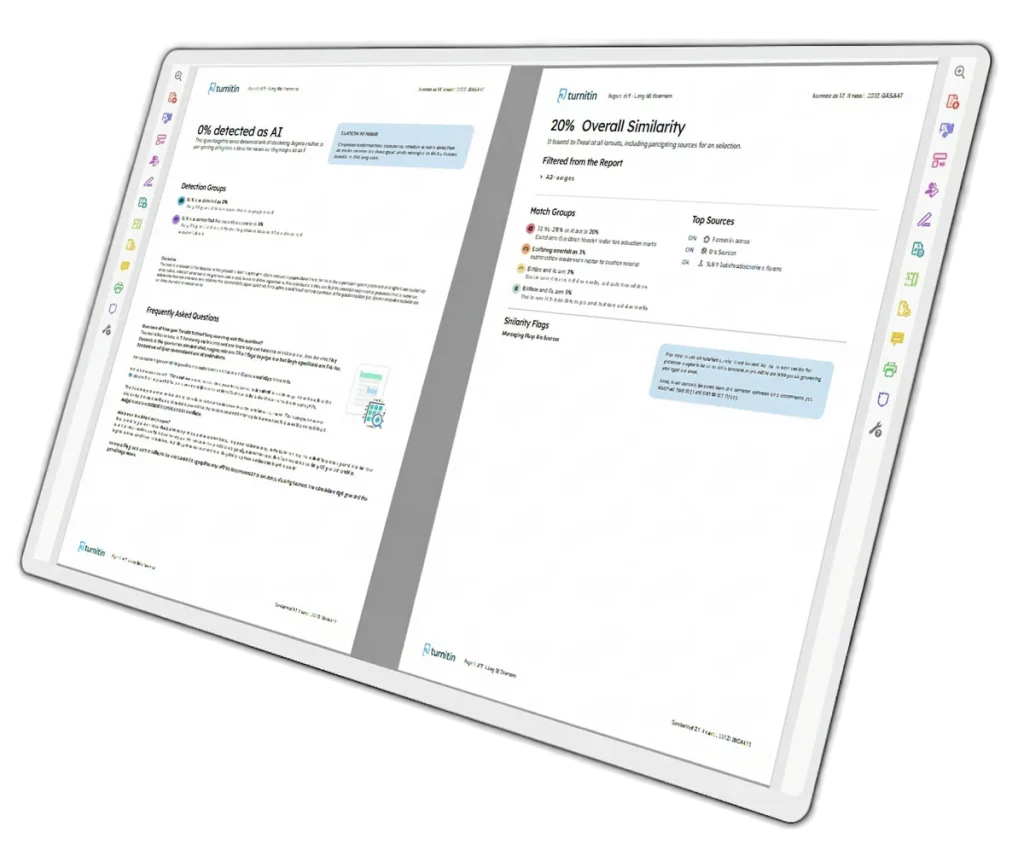
A 0% score means Turnitin found no qualifying AI patterns. This is the result you want, though it offers no protection against similarity-based plagiarism. A paper can score 0% AI while showing 60% similarity with existing sources, so is 60% similarity on Turnitin bad? Similarity and AI are completely separate metrics.
What Are Red Flags in Turnitin?
Beyond percentages, certain patterns draw scrutiny. Inconsistent writing quality within one document, sudden vocabulary shifts, and passages that read as generic or overly polished catch attention. Submitting work with no revision history or essays lacking personal examples function as behavioral red flags.
Is a 35% Turnitin Score Bad? Is 40 AI Detection Bad?
Context determines everything. A 35% score on an essay where you used ChatGPT for brainstorming then wrote the draft yourself might reflect legitimate use. A 40% score on work you claim to have written entirely alone is a serious problem. Some professors now require drafts, outlines, or AI use disclosures alongside final papers.
How Many Percent of AI Is Acceptable?
There is no universal answer. What percentage of AI detection is acceptable on Turnitin depends on your institution. Turnitin considers anything below 20% too unreliable to act upon. Most universities treat scores of 20-40% as conversation starters. Above 40%, formal review becomes standard. Is 18% similarity on Turnitin OK? For similarity, scores under 15% are typically fine, but that is a separate metric from AI detection entirely.
How to Reduce AI Detection in Turnitin
Focus on authentic writing rather than trying to trick the detector:
- Write in your own voice using vocabulary at your actual academic level.
- Vary sentence length. Mix short statements with longer complex ones.
- Include specific examples and personal observations AI rarely generates.
- Save drafts throughout your process. Timestamps are your best defense.
- Use AI tools sparingly for brainstorming, not for generating complete sentences.
Official Turnitin Documentation: For a comprehensive explanation of how the AI detection model handles false positives and interprets scores, refer to the official support guide: Understanding AI writing detection: False positive rates.
The Bottom Line on Turnitin for Students
Turnitin’s AI detection catches obvious machine-written essays and provides useful signals. But it is not forensic evidence. Vanderbilt University calculated that at a 1% false positive rate, thousands of innocent students would face accusations yearly. They disabled the tool. Northwestern and Cornell followed, citing equity concerns.
For you as a student, the takeaway is simple. Write your own work. Save your drafts. A Turnitin scan score starts a conversation; it does not deliver a verdict. If you face a false positive, gather evidence and request a fair review. The detector can be wrong, and Turnitin itself admits that. Your job is to have the documentation to prove it.
Worried about plagiarism scores or AI detection flags? Get the exact same plagiarism & AI report your professor sees in 15-20 minutes. Trusted by thousands of students, researchers, institutions, and agencies.