

Learn how to check and pass Turnitin AI detection. Understand similarity scores, avoid AI flags, and submit your paper with confidence.
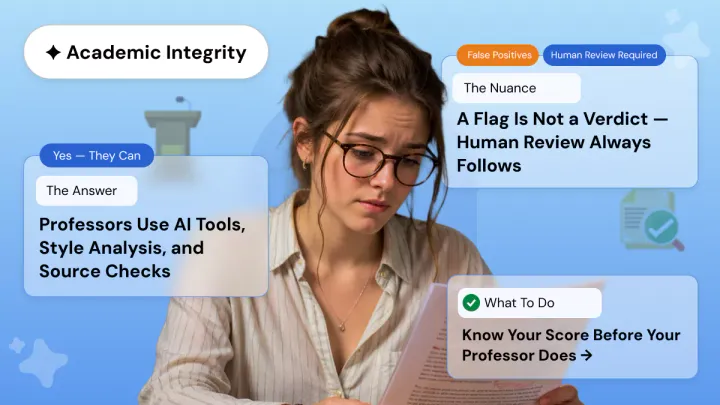
How to Check and Pass Turnitin AI Detection: A Student Guide
A Turnitin check is now standard for most college students. If you are stressed about that similarity percentage or worried about AI detection, you are not alone. Over 200 million papers have been processed through Turnitin since its AI writing detection launched in 2023. This guide breaks down how Turnitin for students works, what those percentages mean, and how to avoid being flagged by Turnitin.
How a Turnitin Scan Actually Works
A Turnitin scan does two things. First, it checks similarity by comparing your text against a database of websites, journals, books, and previously submitted papers. Second, it runs AI detection analysis looking for statistical patterns in sentence structure and word choice that suggest machine-generated text.
Turnitin does not understand your writing. It measures patterns. The similarity score tracks textual overlap, not plagiarism. The AI detection score tracks predictability, not authorship. Knowing this distinction helps you interpret your report correctly.
How to Check If It Passes Turnitin Before Submitting
Many students ask how to check if it passes Turnitin before the final deadline. Your options depend on what your school allows.
If your institution has enabled Turnitin Draft Coach, you can run similarity and citation checks directly inside Google Docs or Microsoft Word before turning anything in.
If Draft Coach is not available, some instructors allow resubmissions. On classic Turnitin assignments, your first three submissions generate reports immediately, but your fourth attempt triggers a 24-hour wait. On newer assignments, you get three resubmissions per calendar day.
If resubmissions are disabled, your first upload is final. Ask your instructor if they can set up a practice assignment for pre-checking.
Official Turnitin Documentation:
For details on student self-checking options, refer to the official Turnitin support guide: Can students check a paper in Turnitin for Similarity before submitting it to an assignment?
Understanding Your Turnitin Score
Is 25% on Turnitin okay? Is 20% on Turnitin okay? Context matters more than the raw number.
Turnitin uses a color-coded system. Blue means zero matches. Green covers 1% to 24%, where most original papers land. Yellow spans 25% to 49% and signals a closer look is needed. Orange hits 50% to 74%. Red means 75% to 100%, which is almost always a problem.
A score of 20% is usually fine if matches come from properly cited quotes, bibliographies, or common academic phrases. Is 23% on Turnitin bad? Not automatically. What matters is the source breakdown. If your 25% comes from fifty sources at 0.5% each, that is normal. If one source accounts for 12% of your paper, you have a problem.
Is a 35% Turnitin score bad? It depends. A literature review might legitimately score higher than an opinion essay. Is a 22% Turnitin score bad? Probably not, if your citations are clean. Is 100% on Turnitin bad? Yes. That usually means your paper was previously submitted. Is a 0% Turnitin score suspicious? It can be. Original prose almost always triggers some background matches, so zero might suggest artificial processing.
Can Turnitin Detect ChatGPT?
Yes, Turnitin can detect ChatGPT-generated text, but its accuracy is imperfect. The system looks for statistical regularity. AI text tends to have consistent sentence length, predictable transitions, and overly clean grammar. Human writing varies in rhythm and breaks patterns.
Turnitin sometimes confuses human writing for AI. Research in PNAS Nexus found over 50% of TOEFL essays by non-native English speakers were wrongly flagged as AI-generated. Formal academic writing can trigger false positives. Turnitin acknowledges its model may misidentify human-written text and advises against using AI detection as the sole basis for adverse action.
How to Pass a Turnitin Test
If you want to know how to pass a Turnitin test, write like a human. Vary your sentence structure intentionally. Alternate short sentences with longer, complex ones. Consistent length looks statistically predictable.
Add personal touches. Share an observation, include a specific example, or state an opinion. AI text has no genuine perspective, so this differentiates your writing.
Avoid over-polished vocabulary. Words like “utilize” or “facilitate” appear constantly in AI output. Use “use” or “help” when they fit. Simple, direct language reads as more human.
Break predictable transitions. AI loves connectors like “furthermore” and “moreover.” Start paragraphs with context, comparison, or direct statements instead.
Add depth to explanations. Show reasoning behind facts, instead of mere restatement.
How to Avoid Similarity in Turnitin
To avoid similarity in Turnitin, paraphrase properly by closing the source and rewriting from your own understanding. Do not simply swap synonyms. That produces awkward writing and does not fool the system.
Cite what needs citing, but limit direct quotes. If more than 10% of your paper is quoted material, your score will climb. Paraphrase where possible and save direct quotes for essential moments.
Ask your professor to exclude your bibliography from the similarity calculation. Reference lists naturally match other papers because similar citation formats appear across student work.
How Can I Humanize My Writing?
If you used ChatGPT to draft your paper, manual editing is required. No tool fully replaces human judgment.
Rewrite the introduction first. AI introductions tend to be generic. Add your own framing or a specific question that motivated your paper.
Rework transitions between paragraphs. Change predictable connectors to reflect your actual reasoning.
Replace abstract examples with concrete, real-life ones. Personal anecdotes or concrete scenarios add unpredictability that detectors struggle to model.
Revise the conclusion. AI conclusions summarize mechanically. A human conclusion emphasizes what matters and acknowledges limitations.
What Humanizer Can Bypass Turnitin?
Students often ask what humanizer can bypass Turnitin. Basic paraphrasers swap words without changing the statistical patterns Turnitin detects. Surface-level rewrites fail because they change how text sounds, not how it thinks.
The most reliable approach is layered. Start with your draft, apply structural rewriting if needed, and then edit manually. Human editing reduces detection risk the most. Building explanations that develop and adapt is how human writing behaves, and it is where detectors struggle most.
Frequently Asked Questions
How to get 0 AI detection on Turnitin?
You do not need 0%. Turnitin’s AI indicator flags suspected content in the 1% to 20% range, which is common. Focus on natural writing rather than chasing a zero.
Is 33% similarity on Turnitin bad?
It depends. If matches are spread across many sources and include cited quotes and bibliography entries, it might be fine. If one or two sources dominate, revise those sections.
How to avoid being flagged by Turnitin?
Use varied sentence structures, include personal perspective, write with simple and direct language, and paraphrase properly rather than swapping synonyms. Keep dated drafts as insurance against false positives.
Worried about plagiarism scores or AI detection flags? Get the exact same plagiarism & AI report your professor sees in 15-20 minutes. Trusted by thousands of students, researchers, institutions, and agencies.