

Get answers to all your Turnitin AI detection questions. Learn what scores mean, how to pass a Turnitin check, and if ChatGPT shows up on scans.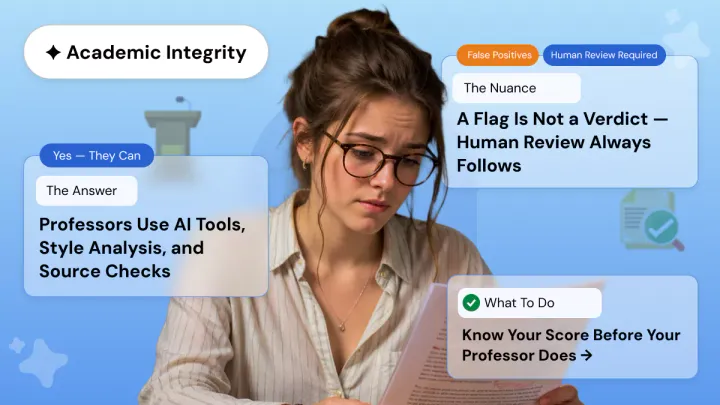
Turnitin AI Detection FAQs: What Every Student Should Know Before Submitting
If you have ever stared at a Turnitin report wondering what those percentages mean, you are not alone. Since Turnitin launched its AI writing detection in April 2023, students everywhere have been trying to figure out how the system works. If you are using Turnitin for students submissions, a Turnitin scan breaks your text into roughly 250-word chunks and analyzes patterns like perplexity (how predictable your word choices are) and burstiness (how much your sentence length varies). The system then generates an AI percentage score. This is an estimate, not a final verdict. As Turnitin itself notes, the AI writing detection model may not always be accurate, so it should not be used as the sole basis for adverse actions against a student.
What Is a Good Turnitin Score?
Turnitin gives you two different numbers: a similarity score and an AI writing score. They measure completely different things.

Check your essay before you submit. See exactly what your professor sees.
Get the exact same Turnitin report your professor uses. Join 50,000+ students who submitted their essays with confidence this semester.
The similarity score tells you how much of your text matches sources in Turnitin’s database of over 1.9 billion submissions plus web content and journals. A similarity score under 15% to 20% is generally acceptable. Some assignments, like literature reviews, will naturally run higher. A score of 0% might signal you have not included enough source material.
The AI writing score works differently. Since July 2024, Turnitin no longer displays exact percentages for scores between 1% and 19%. Instead, you will see an asterisk (*%). Scores of 20% and above display the actual percentage and trigger highlighted sections.
Is 20% on Turnitin Okay? Is 20% AI Detection Bad?
For similarity scores, 20% is usually fine if the matches come from properly cited quotes, references, or common academic phrases. A paper with 20% similarity from well-cited sources is very different from one with 20% from uncited text.
For AI detection, a score below 20% (shown as *%) is generally not a concern. Turnitin designed this threshold to avoid flagging human-written text incorrectly. If you see a number at or above 20%, the system found enough AI-like patterns to warrant attention.
Is 25% on Turnitin Too High? Is 23% on Turnitin Bad?
A 23% or 25% similarity score can still be acceptable depending on your assignment. Review what Turnitin is flagging. If the matches are from your reference list, quoted material with proper citations, or common phrases, your instructor will likely overlook them.
A 25% AI detection score indicates roughly a quarter of your text shows patterns consistent with AI-generated writing. Your instructor may review those flagged sections and ask about your process.
Is a 33% Turnitin Score Bad? Is 35% Turnitin High?
A 33% similarity score is on the higher side but not automatically problematic. If it comes from heavy quoting in a paper where you analyze specific texts, it could be legitimate. A 35% similarity score does warrant a closer look.
For AI detection, scores in the 33% to 35% range suggest a significant portion appears machine-like. Instructors consider the full context, including drafts and your prior writing samples, before making any determination.
Is 42 a Bad Turnitin Score? What Is an Alarming Turnitin Score?
A 42% similarity score is high and will prompt your instructor to examine your report. If much of that comes from uncited text, you could have a problem. Always check what is flagged rather than focusing only on the number.
For AI detection, scores above 40% signal extensive AI tool use. The 60% to 80% range is predominantly AI-like, while 81% to 100% is highly likely AI-generated. So what is an alarming Turnitin score? Above 40% for AI detection should get your attention, and above 60% is genuinely concerning.
Can Turnitin Detect ChatGPT?
Yes. Turnitin can detect text generated by ChatGPT, including outputs from GPT-3.5, GPT-4, GPT-4o, and newer models. The system has processed over 130 million papers for AI detection since launch. It looks for statistical patterns typical of large language models, like consistent sentence structure and predictable word choices.
Since July 2024, the system flags AI-paraphrased text in purple, distinct from cyan highlighting for standard AI-generated text. The August 2025 update added detection for AI bypasser tools, though independent testing shows this is still evolving.
Can Turnitin Detect Paraphrasing? Can Turnitin Detect Copy and Paste?
Turnitin can detect copy-and-paste plagiarism by matching text against its database. If you paste text from a website or another paper without quotation marks and citation, Turnitin will flag it.
For paraphrasing, the similarity checker may flag closely paraphrased text that keeps too many of the same phrases or structures as the original. The AI detection system specifically flags text that was AI-generated and then run through tools like QuillBot. Turnitin claims to detect 64% to 99% of QuillBot-paraphrased content, though practical results vary.
How to Lower Turnitin Score
If your similarity score is higher than you would like:
- Paraphrase ideas in your own words instead of using direct quotes.
- Cite every source properly using the required citation style.
- Avoid overusing templates or shared prompts.
- Use quotation marks and in-text citations for any direct quotes.
- Exclude your reference list from similarity calculations if allowed.
For AI detection scores, write originally. Use AI tools only as permitted, and keep drafts and notes that document your process.
How to Get a 0% on Turnitin
Chasing a 0% similarity score is usually a mistake. Some similarity is expected in academic writing. A 0% score might suggest you have not engaged with existing research. Aim for a score that reflects original analysis supported by properly cited sources.
For AI detection, a 0% score means the system did not identify AI-like patterns. That is positive, though it does not technically guarantee no AI was used.
Can Turnitin Be Wrong?
Yes. False positives occur when human-written text gets flagged as AI-generated. Independent studies found rates around 3% to 4% for native English speakers. Turnitin’s chief product officer stated the system catches about 85% of AI writing while letting 15% through to keep false positives under 1%. Heavily edited AI text may also slip through undetected. No system is perfect.
How to Pass Turnitin AI Check
The honest answer: write your own work. Beyond that:
- Keep all drafts, outlines, and revision notes with timestamps.
- Vary your sentence length and structure naturally.
- Use your own voice rather than overly formal phrasing.
- If AI tools are permitted, disclose how you used them.
- Run your own Turnitin check before the deadline to catch issues early.
If flagged incorrectly, bring process documentation to your instructor. Most educators understand these tools are imperfect.
Is a 0% Turnitin Score Good? Is a 22% Turnitin Score Bad?
A 0% similarity score is not necessarily good. It can indicate a lack of research engagement. A 22% similarity score is not automatically bad; many well-cited papers fall in that range. Always look at what is flagged.
For AI detection, a 22% score displays as an actual number since it exceeds the 20% threshold. The system found meaningful AI-like text, so be prepared to discuss your writing process.
Key Takeaways for Your Next Turnitin Scan
Understanding your Turnitin report does not have to be stressful. Similarity scores and AI detection scores measure different things, and neither is a final judgment on academic integrity. Review what is flagged, keep drafts of your work, and communicate with instructors if questions come up.
Official Turnitin Documentation:
For a comprehensive overview of how Turnitin’s AI detection model works and recent updates to its capabilities, refer to the official support guides: Turnitin’s AI Writing Detection Model.
Worried about plagiarism scores or AI detection flags? Get the exact same plagiarism & AI report your professor sees in 15-20 minutes. Trusted by thousands of students, researchers, institutions, and agencies.