

Looking for a Turnitin check alternative? Explore the best Turnitin equivalents for students and professionals, including free and paid options.
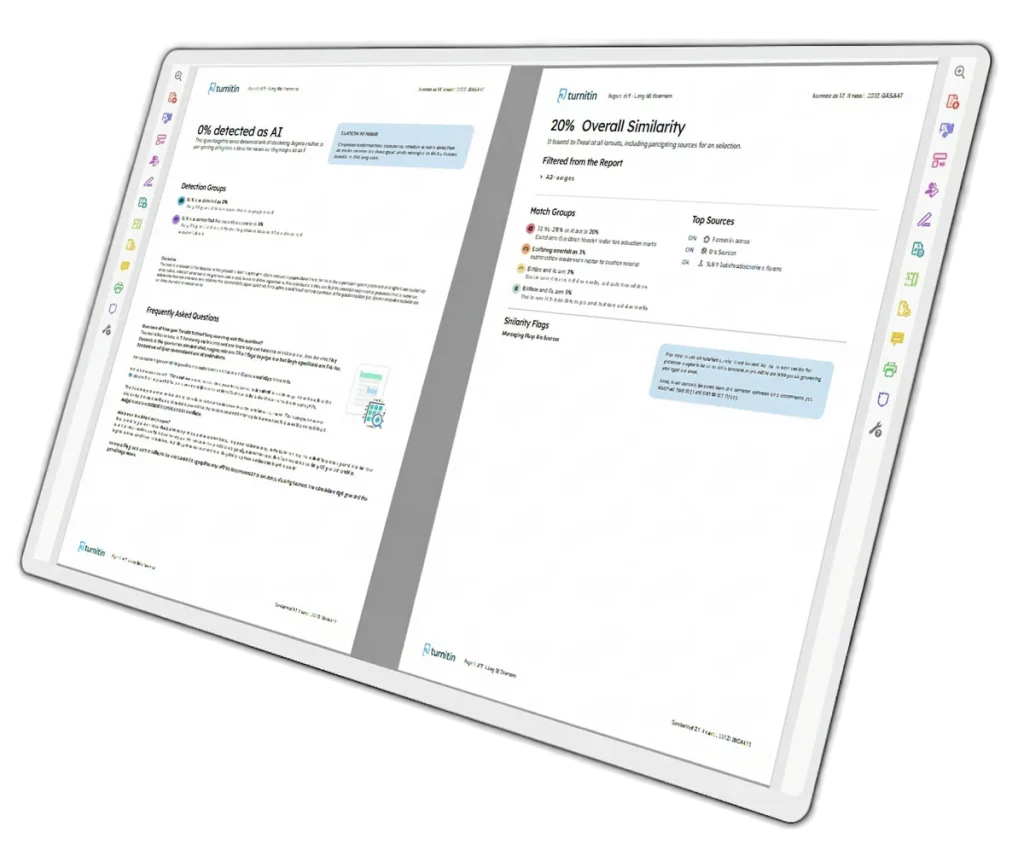
SUMMARY: Turnitin is only available through institutional licenses, leaving individual students, freelance writers, and independent researchers without direct access. Several alternatives now offer comparable or superior capabilities, including plagiarism detection, AI-generated content identification, and privacy-conscious document handling.

Check your essay before you submit. See exactly what your professor sees.
Get the exact same Turnitin report your professor uses. Join 50,000+ students who submitted their essays with confidence this semester.
Tools such as Scribbr, humanfyai, Grammarly, Paperpal, Winston AI, Originality.ai, and Copyleaks vary in database size, AI detection accuracy, pricing, and individual accessibility. The best choice depends on whether the user needs one-time or ongoing checks, prioritizes AI detection, handles sensitive content, or requires research-specific features.
Official Turnitin Equivalents: For Students and Professionals
You need a reliable Turnitin check, but you can’t access it. Maybe your school doesn’t offer it. Maybe you’re an independent researcher or a freelance writer who needs to verify originality before submitting work to a client. Turnitin has dominated the academic integrity space for years, but it comes with a catch: you can’t simply sign up as an individual.
Turnitin sells exclusively to institutions. Universities, colleges, and school districts pay for licenses that cover their entire student body. If you’re not affiliated with one of these organizations, you’re locked out. This leaves millions of students, professionals, and content creators searching for a Turnitin equivalent free or paid that delivers comparable accuracy without the institutional gatekeeping.
Fortunately, the market has evolved. Several high-quality alternatives now match or exceed Turnitin’s core capabilities. Some cater specifically to individual users. Others offer more transparent pricing, better AI detection, or stronger data privacy protections. In this guide, we’ll break down what works, what doesn’t, and how to pick the right tool for your specific situation.
Why You Might Need an Alternative for Turnitin
Turnitin checks over 15,000 institutions worldwide and maintains a database of more than 1.9 billion student papers. Those numbers sound impressive, and they are. But accessibility remains its biggest weakness. Individual students, freelance writers, independent researchers, and professionals working outside academia often have no way to access the platform.
Data retention policies raise another concern. When you submit a paper to Turnitin, it stays in their database indefinitely. Future checks against that same paper will flag it as a match. For students who want to reuse their own original work later, this creates problems. For professionals handling sensitive or proprietary content, storing documents permanently in a third-party database is a dealbreaker.
Pricing opacity adds to the frustration. A 2023 investigation into 60 institutions’ purchasing records revealed that Turnitin charges some colleges three times as much as others for similar services. These inflated costs get passed down to students through tuition and fees, even when they only need occasional scans.
Finally, Turnitin’s AI detection has drawn criticism. Vanderbilt University disabled Turnitin in 2023 after repeated false positives flagged legitimate human writing as AI-generated, particularly for non-native English speakers. Other institutions have followed suit, seeking tools with more transparent scoring and fewer wrongful accusations.
What to Look for in a Turnitin Alternative
Not all plagiarism checkers deliver the same value. Before you commit to a tool, evaluate these factors:
- Database size and coverage. The tool should scan against academic journals, web pages, books, and previously submitted papers.
- AI detection accuracy. With generative AI tools now widespread, you need a checker that flags ChatGPT, Claude, and Gemini output reliably.
- Individual access. You should be able to sign up personally without needing a university email or institutional license.
- Privacy protections. Your documents shouldn’t be stored permanently or used to train AI models without explicit consent.
- Report clarity. Similarity scores should be easy to interpret, with source links and highlighted matches.
- Pricing transparency. You should know exactly what you’ll pay before entering credit card details.
- Accessibility for individuals. If you need a Turnitin for individuals equivalent, confirm that solo users can sign up directly.
The Best Turnitin Alternatives for Students
Students need accurate, affordable tools that work without institutional backing. Here are the strongest options available right now.
humanfyai: Best for AI Detection and Academic Integrity
humanfyai has emerged as the leading Turnitin alternative for students who need both plagiarism and AI detection. Independent benchmarks back this up. The Chicago Booth Benchmark found humanfyai’s AI detector achieves 99.5% accuracy, the highest rating among all publicly available tools.
Unlike Turnitin, humanfyai offers sentence-level AI detection. It breaks down exactly which passages appear AI-generated and which read as human-written. The platform also includes a Writing Replay tool that lets instructors (and students) view the complete writing process inside Google Docs. This matters because it shows how a document evolved, rather than only showing the final result.
humanfyai’s plagiarism checker checks against a massive database of web content and academic sources. It may not match Turnitin’s 1.9 billion student papers, but for pre-submission checks, it catches what matters.
Pricing starts at $12.99 per month when billed annually. A free forever plan exists, though it comes with limited scans. For students who need regular Turnitin scan equivalents without the institutional hassle, humanfyai delivers the closest experience.
Scribbr: Best for Theses and Dissertations
Scribbr runs on Turnitin’s own database, which makes it one of the most accurate plagiarism checkers available to individuals. You pay per document rather than subscribing monthly, with prices ranging from $19.95 for papers under 7,500 words to $39.95 for manuscripts over 50,000 words.
The tradeoff? Scribbr checks plagiarism thoroughly but does not include AI detection in its plagiarism plans. You’d need to use its separate free AI detector, which caps scans at 1,200 words. For doctoral students preparing dissertations, Scribbr remains the gold standard for similarity checking. For AI detection, you’ll want to pair it with another tool.
Grammarly: Best All-in-One Writing Tool
Grammarly Premium bundles grammar checking, style suggestions, plagiarism detection, and AI detection into one subscription at roughly $12 per month. It scans against 16 million web pages and ProQuest academic papers.
The plagiarism checker works well for everyday assignments but falls short for high-stakes academic work. Reviews consistently note that Grammarly misses paraphrased content and produces hit-or-miss results on AI detection. Its accuracy ranges from 54% to 97% depending on the text type, which is too wide a gap to trust for critical submissions.
That said, if you want a single tool that handles grammar, tone, plagiarism, and basic AI checking, Grammarly offers convenience that specialized tools can’t match. For students on a tight budget, Grammarly represents the most practical free alternative for Turnitin through its generous free grammar tier, though you’ll need Premium for plagiarism and AI detection features.
Paperpal: Best for Researchers
Paperpal targets academic researchers specifically. It combines plagiarism checking, AI detection, grammar correction, and manuscript preparation tools in one platform. The free tier includes 7,000 words of plagiarism checking per month and five daily AI detection scans up to 1,200 words each.
Paperpal also includes 30+ pre-submission checks designed for journal manuscripts, a citation generator covering 10,000+ academic styles, and translation across 50+ languages. At $25 per month for the Prime plan, it costs more than some competitors but includes tools that no other platform offers at this price point.
Data security stands out here. Paperpal holds ISO 27001 certification and explicitly states that documents are never used to train AI models. This directly addresses one of Turnitin’s most criticized practices.
Free Turnitin Equivalents: What Actually Works
Budget matters for students. Let’s look at what you can get without paying.
Quetext: Best Free Option for Short Papers
Quetext offers a genuinely useful free tier that checks up to 500 words at a time. It provides contextual matching, which means it understands the surrounding text rather than just hunting for exact word matches. This catches more subtle forms of plagiarism than basic free tools.
The downside? The free plan is limited. You’ll hit the paywall quickly if you write longer papers. The Pro plan runs about $10 per month and removes the word cap.
DupliChecker: Best for Quick, No-Signup Checks
DupliChecker lets you paste up to 1,000 words without creating an account. It’s fast, simple, and accurate enough for basic copy-paste detection. However, it misses paraphrased content, offers no AI detection, and displays ads on the free version. Think of it as a first-line scanner, not a comprehensive solution.
PlagCheck: Best Free Daily Allowance
PlagCheck gives registered users 300 free words per day with plagiarism and AI detection included. That’s roughly one page of academic text every 24 hours. For students who write in stages and want to check as they go, this daily allowance works well. No institutional account required.
The Best Turnitin Alternatives for Professionals
Working professionals face different challenges than students. You might handle proprietary content, client work, grant proposals, or publishable research. You need tools that respect confidentiality while delivering publication-ready accuracy.
Winston AI: Best for Content Teams and Publishers
Winston AI targets publishers, agencies, and professional writers who need defensible originality reports. It claims 99.98% detection accuracy and provides transparent probability scores for every scanned sentence. This matters when you’re explaining results to clients, editors, or compliance teams.
Unlike Turnitin, Winston AI offers individual subscriptions with no institutional requirements. It handles multilingual content well and actively minimizes false positives, a known weakness in Turnitin’s AI detection system.
Originality.ai: Best for Content Agencies
Originality.ai started as a tool for SEO agencies and content marketers, but its 99% claimed accuracy on AI detection has made it popular among professional writers. It includes a unique fact-checking aid that flags potentially inaccurate claims and provides context links, helping reduce AI hallucinations in generated content.
At $14.95 per month, it’s competitively priced. The scan history feature lets you track changes across document drafts, which is useful for long-form projects that evolve over multiple revisions.
Copyleaks: Best for Enterprise and Multilingual Content
Copyleaks scans against 60 trillion web pages, 16,000+ open-access journals, and 20+ code repositories. It supports 100+ languages and can perform cross-language plagiarism checks, meaning it can detect if a Spanish document contains translated content from an English source.
For professionals working in global contexts, this multilingual capability is hard to beat. Pricing starts at $13.99 per month for the combined AI and plagiarism detection plan.
Turnitin AI Detection vs. Competitors: How They Compare
Turnitin added AI detection in April 2023, but its rollout hasn’t been smooth. The system has struggled with false positives, particularly on structured academic writing and non-native English submissions. Independent testing shows variable performance depending on the AI model used to generate the text and how much editing was applied afterward.
| Tool | AI Detection Accuracy | False Positive Rate | Individual Access |
|---|---|---|---|
| Turnitin | Moderate | Reported high | No |
| GPTZero | 99.5% | Lowest in market | Yes |
| Copyleaks | 99.1% | Low | Yes |
| Originality.ai | 99% | Low | Yes |
| Grammarly | 54-97% (variable) | Moderate | Yes |
The data tells a clear story. Several alternatives now exceed Turnitin’s AI detection accuracy while remaining accessible to individual users. If Turnitin AI detection is your primary concern, you have better options available.
How to Choose the Right Tool for Your Needs
Picking the best alternative to Turnitin depends on what you actually need. Ask yourself these questions:
Are you checking a one-time submission or ongoing work?
For one-off checks, Scribbr’s pay-per-document model saves money. For regular use, a monthly subscription to GPTZero or Grammarly makes more sense.
Is AI detection a priority?
If you need to verify that content is human-written, prioritize GPTZero, Copyleaks, or Originality.ai. Grammarly’s AI detection is too inconsistent for high-stakes verification.
Do you handle sensitive or proprietary content?
Check the privacy policy. Paperpal, PlagCheck, and Scribbr explicitly avoid storing your documents after processing. Turnitin keeps everything forever, which creates problems if you later want to publish or reuse your own work.
What’s your budget?
Free options exist but come with tradeoffs. Quetext limits you to 500 words. DupliChecker shows ads. PlagCheck gives you 300 words daily. For serious academic or professional work, investing $10-25 per month in a paid tool pays for itself in accuracy and peace of mind.
What Is Equal to Turnitin? The Honest Answer
No single tool perfectly replicates every feature Turnitin offers. Its 1.9 billion student paper database remains the largest in existence, and its institutional integrations with Canvas, Moodle, and Blackboard are deeply embedded in academic workflows.
However, if you need the closest thing to Turnitin for actual originality checking, the answer depends on your use case:
- For AI detection: GPTZero exceeds Turnitin in accuracy and transparency.
- For plagiarism checking against academic sources: Scribbr uses Turnitin’s own database and is available to individuals.
- For all-in-one writing support: Grammarly covers grammar, style, plagiarism, and basic AI detection in one subscription.
- For research manuscripts: Paperpal offers specialized academic tools that Turnitin lacks.
- For professional content: Winston AI and Originality.ai provide defensible reports suitable for client work.
Official Turnitin Documentation
For a comprehensive explanation of how Turnitin generates and interprets similarity scores, refer to the official support guides: Understanding the similarity score.
Final Thoughts
You don’t need institutional access to verify your work’s originality. The best alternative for Turnitin in 2026 is whichever tool matches your specific workflow, budget, and accuracy requirements. GPTZero leads on AI detection. Scribbr leads on academic plagiarism checking. Paperpal leads on research-specific features. Grammarly leads on convenience.
Start with free trials. Test how each tool handles your actual writing. Check if the similarity reports make sense, if the AI detection flags feel accurate, and if the privacy policies respect your work. The right tool is the one that catches problems before they become problems, giving you confidence that what you submit is genuinely yours.
For students locked out of Turnitin and professionals who need reliable originality verification, these alternatives do more than fill the gap. In several key areas, they outperform the original.
Worried about plagiarism scores or AI detection flags? Get the exact same plagiarism & AI report your professor sees in 15-20 minutes. Trusted by thousands of students, researchers, institutions, and agencies.