

Find the most accurate AI content detector for academic writing. Compare Turnitin AI detection, GPTZero, Originality.ai, and more for students.
If you have ever submitted a paper through a Turnitin check and stared nervously at the results, you are not alone. Millions of students and educators now rely on AI detection tools to verify academic writing. With ChatGPT, Claude, and similar tools everywhere, universities face a tough question: which detector actually gets it right?

Check your essay before you submit. See exactly what your professor sees.
Get the exact same Turnitin report your professor uses. Join 50,000+ students who submitted their essays with confidence this semester.
Which AI Detector Is Best for Academic Writing?
The answer depends on what you need. No single detector catches everything.
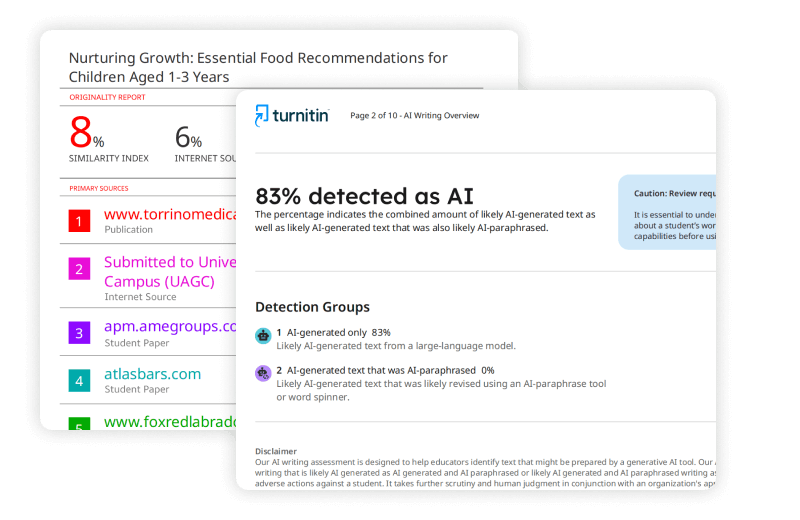
Turnitin leads the pack for institutional use. Over 16,000 schools use it, and its AI detection integrates directly into the submission workflow professors already know. When you run a Turnitin scan, the system analyzes writing patterns and sentence variation to flag AI-generated text. Turnitin claims 98% confidence, though independent studies show mixed results.
GPTZero has gained serious traction among educators. Independent benchmarks show it hitting roughly 99% accuracy on pure AI-generated content. It was the first major detector to classify text as “mixed” human and AI, which matters because most student submissions fall somewhere in between. The free tier covers 10,000 words per month.
Originality.ai offers another strong option, with accuracy above 95% and paraphrase detection that catches text run through tools like QuillBot. Copyleaks sits at 90-92% accuracy and integrates well with learning management systems.
For students who want to check their own work before submission, options are limited. Most Turnitin for students access is controlled by institutions. You typically cannot run an independent Turnitin AI detection check without going through your school’s portal.
A Quick Comparison of Top Detectors
| Tool | Accuracy on Pure AI Text | Best For | Student Self-Check |
|---|---|---|---|
| Turnitin | 77-94% | Institutional use, integrated workflows | Limited (institution-controlled) |
| GPTZero | ~99% | Educators, mixed content detection | Yes (free tier available) |
| Originality.ai | 95%+ | High-stakes academic review | Yes (paid) |
| Copyleaks | 90-92% | LMS integration, batch processing | Yes (freemium) |
| Sapling | ~68% | Quick checks, basic use | Yes (free) |
How Hard Is It to Detect AI Text?
Harder than most people think.
AI detectors look for patterns: repetitive phrasing, predictable word choices, uniform sentence length, and low “perplexity” (a measure of how surprising the next word is). Human writing has variation. We write short sentences. Then we write longer, more complex ones with unexpected turns. AI tends to hover in the middle, producing grammatically perfect but stylistically flat prose.
The challenge grows when humans edit AI-generated text. A 2024 study from Temple University tested Turnitin against hybrid texts, part human-written and part AI-generated. Turnitin correctly identified only 43% of these mixed submissions. When students rewrite AI output or use AI only for outlining, detection rates drop.
False positives pose another problem. AI detectors sometimes flag human-written text, especially formal academic prose or writing by non-native English speakers. Stanford researchers found that some detectors incorrectly classified over 60% of text samples from non-native speakers as AI-generated. Turnitin has tuned its model to reduce this issue, but no system is perfect.
Heavily edited AI text becomes nearly impossible to catch. If a student writes a draft, runs it through ChatGPT for grammar cleanup, and revises again, the result often registers as human. Turnitin acknowledges this. Its detection works best on raw, unmodified AI output.
What Makes AI Detection So Tricky?
- Human-edited AI text masks machine patterns
- Formal academic writing structurally resembles AI output
- Non-native English speakers sometimes write in patterns detectors misread
- Newer AI models produce increasingly human-like text
- Short texts and lists often fall outside detection parameters
What Is the Most Accurate AI Content Detector?
If accuracy on pure AI text is your only metric, GPTZero currently leads independent tests. It correctly identifies AI-generated content over 99% of the time when the text is unmodified. Its sentence-level highlighting shows exactly which passages triggered the flag.
For institutional reliability, Turnitin remains the standard. Its integration with grading workflows and similarity checking alongside AI detection make it the practical choice for universities. A Turnitin check gives professors both plagiarism and AI analysis in one report.
Originality.ai offers the most comprehensive feature set. Its paraphrase detection catches attempts to hide AI use through rewriting tools.
No detector is 100% accurate. Turnitin estimates it catches about 85% of AI-generated text, letting 15% slide to keep false positives under 1%. That protects students from wrongful accusations but means some AI use goes undetected.
Does Writer Have an AI Content Detector?
Yes. Writer.com includes an AI content detection feature as part of its broader writing platform. It checks for patterns associated with AI-generated text and provides a confidence score. However, in independent comparisons, Writer lags behind specialized tools like GPTZero and Originality.ai. Its accuracy sits in the middle of the pack, making it useful as a supplementary check but not ideal as a primary academic screening tool.
Other platforms like QuillBot also offer detection features, though these are bundled with paraphrasing and grammar tools. The general rule holds: dedicated detection tools outperform add-on features.
Tips for Students Using AI Detection Tools
If you are a student wondering how to stay on the right side of AI policies, here are practical steps you can take:
- Know your institution’s rules. Some schools allow AI for brainstorming or outlining. Others prohibit it entirely. Check your policy first.
- Keep your drafts. Save every version of your work. If a professor questions your submission, you can show your process.
- Use AI for editing sparingly. Running your own writing through a grammar checker is usually fine. Having AI rewrite entire paragraphs is where problems start.
- Run your own check first. Use GPTZero or a similar tool to scan your work before submission if your school allows it.
- Cite everything. If you use AI-generated content or ideas, disclose it. Transparency protects you better than any detector.
Official Turnitin Documentation
For official guidance on how Turnitin handles student submissions and similarity reports, refer directly to their support resources. You can find detailed information about checking papers before submission here: Can students check a paper in Turnitin for Similarity before submitting it to an assignment?
The Bottom Line
So what is the most accurate AI content detector for academic writing? GPTZero wins on raw detection accuracy. Turnitin wins on institutional integration and workflow familiarity. Originality.ai offers the strongest feature set for catching sophisticated attempts to hide AI use.
For students, the best strategy is not to find the best detector. It is to write your own work, document your process, and use AI only within the boundaries your school allows. Academic integrity is not about beating the system. It is about doing honest work you can stand behind.
If you need to run a Turnitin check or compare your work against AI detection benchmarks, use the tools available through your institution. Ask your instructor about Turnitin for students access, and always review your Turnitin scan results carefully before final submission. The tools will improve, but nothing replaces genuine effort and original thinking.
Worried about plagiarism scores or AI detection flags? Get the exact same plagiarism & AI report your professor sees in 15-20 minutes. Trusted by thousands of students, researchers, institutions, and agencies.