

Understand how Turnitin’s similarity and AI detection scores actually work, what the numbers mean, and how to keep your academic writing genuinely your own.
Bypass AI Essay Detector: What Students Actually Need to Know
You have a paper due tomorrow. The deadline is creeping closer, and you are staring at a blank screen, wondering if using AI to get started will come back to haunt you. You are not alone. In a 2024 BestColleges survey, 56% of college students admitted to using AI on assignments or exams. The question is not whether students are turning to AI. It is how to produce work that passes a Turnitin check without landing in front of an academic integrity board.

Check your essay before you submit. See exactly what your professor sees.
Get the exact same Turnitin report your professor uses. Join 50,000+ students who submitted their essays with confidence this semester.
This guide cuts through the noise. You will learn how Turnitin for students actually works, what those similarity and AI scores mean, and how to keep your writing genuinely yours.
How Turnitin Checks Your Work
Turnitin runs two separate scans on every submission. Understanding both is key to staying on the right side of your instructor’s grading rubric.
The Similarity Scan
Turnitin compares your paper against its massive database, which includes billions of web pages, academic journals, and previously submitted student work. It spits out a similarity score showing what percentage of your text matches existing sources. This score does not mean you plagiarized. A high score could simply mean you used a lot of properly cited quotes. A low score, even 0%, might signal you did not include enough research. Context matters here.
The AI Detection Scan
Since 2023, Turnitin has layered an AI detection engine on top of its similarity checker. This system does not compare your text against a database. Instead, it analyzes linguistic patterns in roughly 250-word segments. It looks at how predictable your word choices are (perplexity) and how much your sentence length varies (burstiness). AI tends to write with consistent rhythm and statistically likely word combinations. Human writing is messier. We switch gears mid-paragraph. We drop a short sentence after a long one. That unpredictability is what Turnitin’s AI scanner hunts for.
The system flags suspected AI text in cyan. Since July 2024, it also highlights AI-paraphrased content in purple. If your professor sees purple, they know you did not just use AI. You tried to hide it. That is a much worse position to be in.
Can Turnitin Detect ChatGPT?
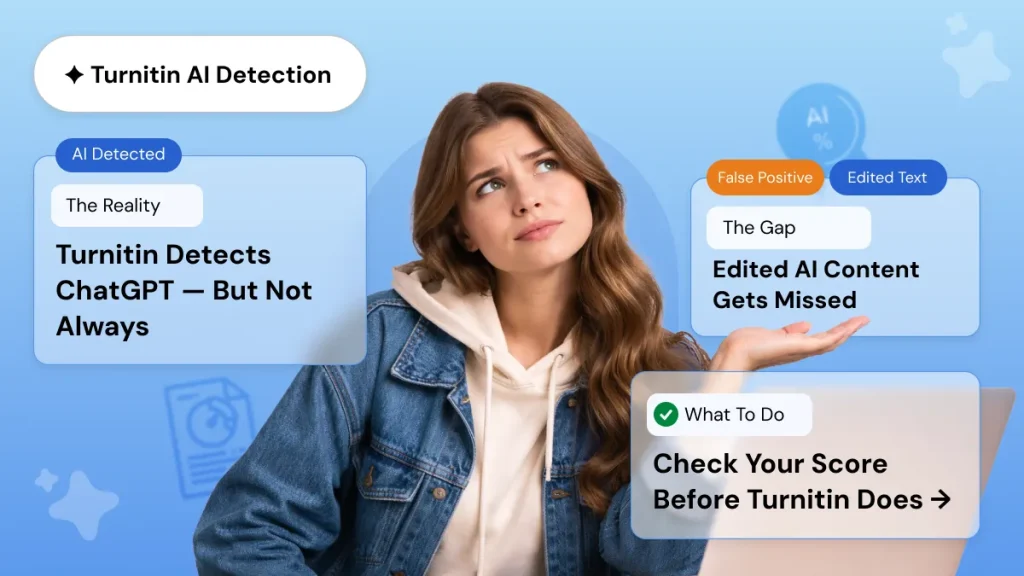
Yes, Turnitin can detect raw ChatGPT output with roughly 98% accuracy on unmodified text. But here is where it gets interesting. Once you edit, paraphrase, or rewrite that output, detection accuracy drops sharply. Independent testing from 2024 found that Turnitin’s detection rate falls to between 20% and 63% on edited AI content. Claude-generated text is even harder for Turnitin to catch consistently, with detection rates as low as 53-60%.
So can Turnitin detect paraphrasing? It depends. Basic paraphrasing tools sometimes slip through. But Turnitin updated its model in August 2025 specifically to catch AI bypasser tools and humanizers. The arms race is ongoing. Turnitin improves, evasion tools adapt, and the cycle continues.
Understanding Your Turnitin Score
Let us tackle the questions students Google at 2 AM.
What Do the Numbers Actually Mean?
Most institutions consider a similarity score under 15-20% generally safe. But there is no magic cutoff. A score of 22% with properly cited sources is far less concerning than a score of 12% with a single uncited paragraph copied from one website. Your professor looks at the report, not just the number.
- Is 20% on Turnitin okay? Usually, yes. If your matches come from citations and common phrases, you are fine.
- Is 25% on Turnitin too high? Not automatically. It warrants a closer look, but properly referenced quotes can push you into this range legitimately.
- Is a 0% Turnitin score good? Surprisingly, not always. It might mean you failed to include source-based evidence, which many assignments require.
- Is 35% Turnitin high? Yes. At this level, you are likely over-relying on external text or missing citations.
- Is 42 a bad Turnitin score? It is concerning. Roughly 40% of your paper matches other sources. Time to rewrite.
What About AI Detection Scores?
Turnitin displays AI scores differently. A score of 0% means no AI was detected. Scores from 1-19% show an asterisk (%*) because Turnitin considers this range unreliable. Scores from 20-100% come with cyan or purple highlights and are treated as the “reliable” detection zone.
- Is 20% AI detection bad? It depends on your school’s policy. Many institutions use 20% as the threshold for further investigation.
- Is 23% on Turnitin bad? If this is your similarity score, probably not. If it is your AI detection score, your instructor will likely ask questions.
- Is a 22% Turnitin score bad? Context matters. Similarity of 22% with good citations is normal. AI detection of 22% is a red flag.
- Is a 33% Turnitin score bad? For similarity, it is high but could include legitimate matches. For AI detection, it is very likely to trigger academic review.
How to Pass a Turnitin AI Check the Right Way
Let us be direct. The only reliable way to pass a Turnitin scan is to write the paper yourself. But that does not mean you cannot use AI responsibly during the process.
Use AI as a Starting Point, Not a Final Draft
AI tools can help you brainstorm topics, generate outlines, or explain complex concepts. That is fair use. The problem starts when you copy AI-generated paragraphs directly into your submission. Instead, take those ideas, find your own sources, and write the argument in your own voice. Your natural writing style, with all its quirks and inconsistencies, is your best defense against any AI detector.
Cite Everything
If you use AI to help generate ideas or draft sections, check whether your instructor requires disclosure. Many universities now have specific policies about AI use. When in doubt, cite it. Transparency protects you.
Keep Your Drafts
This is the single most useful habit you can build. Save every version of your paper. Screenshot your research. Keep your notes. If Turnitin flags your work, you can demonstrate your process. Google Docs version history does not lie. A student at UC Davis was cleared of AI cheating allegations after showing drafts and research notes that proved human authorship. Evidence wins disputes.
Can Turnitin Be Wrong?
Absolutely. Turnitin admits to a less than 1% false positive rate for native English speakers, but independent studies paint a different picture. Research from Stanford found that AI detectors falsely flag writing by non-native English speakers as AI-generated 61% of the time. Instructors have reported flagging students’ fully original work at over 90% AI-generated. The tool is not infallible.
If you believe Turnitin flagged your work incorrectly, request the detailed report. Ask to see which segments were highlighted. Then present your evidence: drafts, notes, browser history, anything showing your paper evolved over time. Turnitin’s own terms state that AI scores should not be used as the sole basis for adverse actions against a student. If your professor treats the score as proof, that is a policy violation.
Official Turnitin Documentation:
For a deeper understanding of how similarity scores work and what they represent, refer to the official Turnitin guide: ‘Interpreting the Similarity Report’.
How to Lower Your Turnitin Score
If your similarity score came back higher than expected, here is how to fix it.
- Paraphrase in your own words instead of quoting directly. Always cite the source anyway.
- Cut down on long block quotes. Your professor wants to read your analysis, not a string of other people’s sentences.
- Check if your reference list or bibliography is inflating the score. Ask your instructor if they can exclude references from the report.
- Avoid copying and pasting from websites, even if you plan to rewrite later. Start with a blank page and your own words.
What Is an Alarming Turnitin Score?
There is no universal alarm bell, but here is a practical breakdown. Similarity scores above 40% almost always warrant investigation. AI detection scores above 20% with clear highlighting will prompt most instructors to start asking questions. Purple highlighting (AI-paraphrased content) is worse than cyan because it suggests intentional evasion. Two students with identical scores can face completely different outcomes depending on what Turnitin actually flagged.
Frequently Asked Questions
How do I get a 0% on Turnitin?
You probably do not want one. A 0% similarity score suggests your paper contains no matches to any source, which might mean you skipped the research phase. Some similarity is expected and even desired in academic writing.
Can Turnitin detect copy and paste?
Yes. Direct copy-paste from websites, journals, or other student papers is exactly what Turnitin’s similarity checker was built to catch. It is the most reliable thing the tool does.
How do I know if my Turnitin score is okay?
Check your syllabus. Ask your instructor. Different assignments and different professors have different expectations. There is no single number that works everywhere.
Does Turnitin store my paper forever?
Turnitin adds submitted papers to its database to check against future submissions. This is how it catches collusion and self-plagiarism. If you submit a draft first, make sure your instructor has set the assignment to exclude drafts from the repository.
What should I do if I am falsely accused?
Gather your evidence. Show your drafts, notes, and revision history. Reference Turnitin’s own guidance that AI scores should not be the sole basis for disciplinary action. Know your school’s appeals process and use it.
Worried about plagiarism scores or AI detection flags? Get the exact same plagiarism & AI report your professor sees in 15-20 minutes. Trusted by thousands of students, researchers, institutions, and agencies.